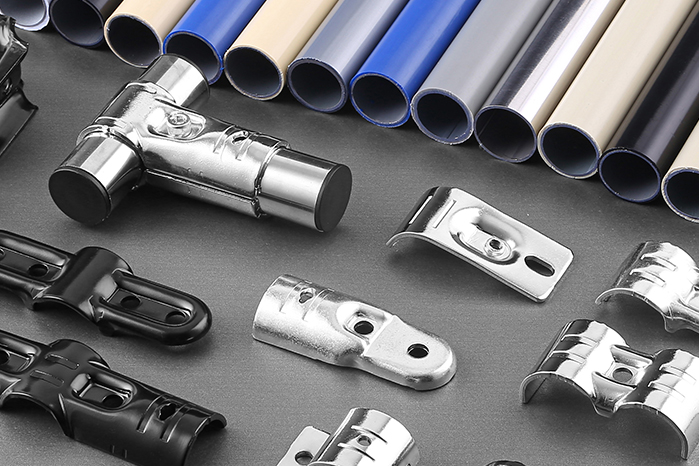
The automotive industry is the historical birthplace of “Lean” philosophy, where the pursuit of eliminating waste and maximizing value began with the Toyota Production System. Today, as vehicle manufacturing shifts toward electric drivetrains and modular platforms, the internal logistics of the factory floor must be equally adaptable. Lean pipe manufacturing production has emerged as the gold standard for creating the specialized, agile infrastructure required to handle thousands of unique components—from micro-chips to heavy engine blocks—with surgical precision.
In an automotive assembly plant, the “one-size-fits-all” approach to shelving is obsolete. Instead, engineers require bespoke solutions that can be prototyped, tested, and deployed in a single shift. This is where the modular lean tube becomes an indispensable asset in the 2B supply chain.
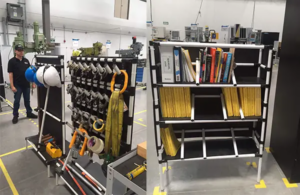
Revolutionizing Line-Side Logistics with Flow Racks
One of the most prominent use cases in automotive facilities is the implementation of gravity-fed flow racks. In a high-speed assembly line, every second an operator spends reaching for a part or walking to a distant pallet is “Muda” (waste).
By utilizing lean pipe manufacturing production techniques, facilities can create high-density flow racks that sit directly at the line-side. These racks use a slight incline and roller tracks to ensure that as soon as a worker picks a component, the next one slides forward into the ergonomic “strike zone.” This ensures a strict First-In, First-Out (FIFO) inventory flow, which is critical for tracking batch numbers and ensuring that sensitive rubber or electronic components do not sit in inventory for too long.
Custom Kitting Carts for Sub-Assembly
Modern automotive manufacturing relies heavily on “kitting”—the process of pre-sorting all the specific parts needed for a single vehicle into a mobile unit that follows the chassis down the line. A standard industrial cart is often too bulky or poorly laid out for this task.
Modular systems allow for the creation of custom kitting carts tailored to the specific geometry of door panels, instrument clusters, or wire harnesses. Because the lean tube is lightweight yet structurally robust, these carts can be easily maneuvered by AGVs (Automated Guided Vehicles) or manual tuggers. The ability to add padded foam linings or specialized hooks directly to the pipe frame protects Class-A surfaces—like painted fenders or leather interiors—from scratches during transport, a common issue with traditional heavy steel trolleys.
Ergonomic Workstations and “Karakuri” Automation
Ergonomics is a primary concern for Tier-1 automotive suppliers. A workstation that is too high or too low leads to repetitive strain injuries and decreased throughput. With modular pipe systems, the height, angle, and reach of a workbench can be fine-tuned to the individual operator.
Furthermore, the automotive sector frequently utilizes “Karakuri” kaizen—a form of mechanical automation that uses gravity and counterweights instead of electricity or pneumatics to move parts. Lean pipe manufacturing production is the ideal medium for building these clever mechanical linkages. For example, a rack can be designed so that the weight of an empty box being placed on a return lever triggers the next full box to drop into position. This “low-cost-automation” reduces energy consumption and maintenance complexity on the shop floor.
Engineering Excellence for the Automotive Sector: Our Role at JunYi
At JunYi, we understand that the automotive industry operates on razor-thin margins and uncompromising quality standards. As a partner focused on 2B industrial solutions, we provide the raw materials and technical expertise necessary to fuel these high-efficiency environments. When we talk about our role in the supply chain, we view ourselves not just as a supplier, but as a critical enabler of automotive agility.
Our lean tube products are engineered to withstand the rigorous, multi-shift demands of an automotive assembly plant. We ensure that our pipes feature high-tensile strength and a resilient outer coating that resists the oils, coolants, and cleaning agents common in engine and transmission manufacturing. By focusing on the precision of our manufacturing, we ensure that every joint and tube fits perfectly, preventing the structural “wobble” that can plague lower-quality modular systems.
OEM and ODM Partnerships for Global Automotive Suppliers
We recognize that large-scale automotive OEMs (Original Equipment Manufacturers) and their Tier-1 suppliers require more than just off-the-shelf parts. This is why JunYi places a heavy emphasis on our OEM and ODM capabilities. We work closely with plant engineers to develop specialized components that meet unique internal standards—whether that involves specific ESD-safe coatings for electric vehicle (EV) battery assembly or high-visibility color-coding for different sections of the factory.
Our commitment to lean pipe manufacturing production excellence means we maintain a deep inventory and streamlined production cycles. We know that in the automotive world, a delay in infrastructure can lead to a delay in a vehicle launch. By leveraging our manufacturing scale, we provide our B2B clients with the rapid response times they need to reconfigure their lines for the next generation of mobility.
Sustainability and the Future of the Factory
As the automotive industry moves toward carbon neutrality, the “reusability” of our systems offers a significant environmental advantage. Unlike welded racks that end up in a scrap yard when a model line is discontinued, our lean tube systems can be disassembled and rebuilt into entirely new configurations for the next project.
At JunYi, we are proud to support the automotive industry’s transition toward a more sustainable and efficient future. By providing the flexible building blocks for modern manufacturing, we help our partners stay lean, stay fast, and stay competitive.