In the world of industrial procurement, the “lowest sticker price” is often a siren song that leads to graveyard-filled warehouses of obsolete equipment. For enterprise-level manufacturing and logistics hubs, the true metric of success is the Total Cost of Ownership (TCO) and the long-term ROI of facility infrastructure. As global supply chains face increasing volatility, the transition from rigid, permanent fixtures to modular lean pipe manufacturing solutions has proven to be one of the most financially sound strategic shifts a B2B entity can make.
The value of a lean tube system is not found merely in its assembly, but in its ability to evolve. While traditional welded steel or heavy timber racking systems depreciate as “static assets,” modular pipe systems function as “dynamic capital,” capable of being harvested, reconfigured, and redeployed across decades of shifting production cycles.
Asset Longevity and Material Resilience
A common pitfall in industrial planning is underestimating the environmental toll of a high-traffic factory floor. Standard steel racks are prone to structural fatigue at weld points and surface oxidation that can contaminate sensitive products. High-quality lean pipe manufacturing solutions address this through advanced material science.
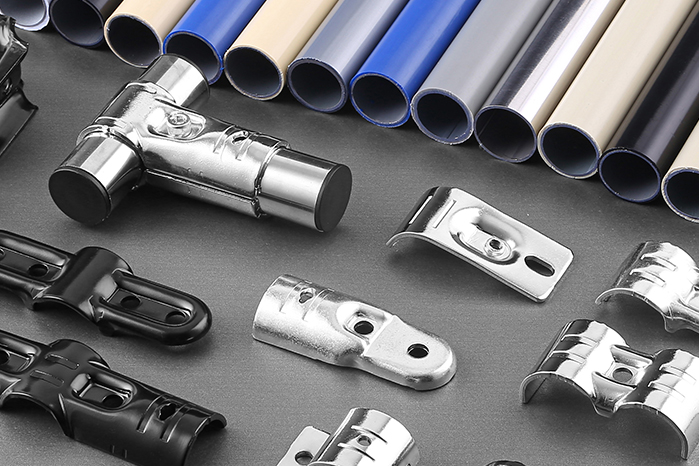
Modern lean tubes are typically constructed from cold-rolled steel with a multi-layered protective barrier—often a high-adhesion PE or ABS plastic coating, or a chrome-plated finish. This design ensures that the structural core remains shielded from the corrosive effects of humidity, industrial chemicals, and physical impacts. Over a ten-year horizon, a facility using these modular solutions avoids the recurring costs of sanding, repainting, and structural reinforcement required by traditional ironworks.
The “Zero-Waste” Approach to Infrastructure
In a traditional manufacturing setup, a change in product dimensions often renders existing racks and workstations useless. These “monuments” to old processes are usually sold for scrap at a fraction of their original value. This is where the long-term value of the lean tube truly shines.
Because the system is held together by mechanical compression joints, every single component—from the 4-meter pipe to the smallest T-joint—is 100% reusable. When a production line is decommissioned, the hardware is simply disassembled and returned to a “supermarket” of parts, ready to be built into a completely different configuration, such as a gravity-feed flow rack or an ergonomic packing station. This circular economy within the factory floor virtually eliminates the capital expenditure (CAPEX) usually required for new project launches.
Labor Efficiency and “Speed to Market”
Time is the most expensive variable in any B2B operation. Traditional fabrication requires specialized labor, such as certified welders, and often necessitates “hot work” permits that can shut down entire sections of a plant for safety.
Lean pipe manufacturing solutions empower the existing workforce. With basic training, a facility’s own maintenance team can build custom solutions in real-time. This “Speed to Market” allows companies to:
- PrototypeImmediately: Create a mockup of a new cell and test it for ergonomics before committing to a final design.
- Reduce Downtime: Perform repairs or adjustments during a 30-minute shift break rather than waiting for an outside contractor.
- Optimize Space: Incrementally adjust shelf heights to reclaim vertical space, often delaying or eliminating the need for expensive warehouse expansions.
Strategic Partnership: Why JunYi is the Modular Choice
At JunYi, we do not view ourselves simply as a hardware vendor; we are a strategic partner in our clients’ long-term operational excellence. We recognize that for our 2B customers, the reliability of a lean tube is the foundation of their production uptime. Our manufacturing philosophy is rooted in the belief that industrial components should be “invisible”—they should work so well and last so long that you never have to worry about them.
We have optimized our production lines to ensure that every pipe and joint leaving our facility meets exacting industrial tolerances. This precision is what allows our systems to be disassembled and reassembled hundreds of times without losing the “grip” or structural integrity that cheaper, non-standard imitations often sacrifice. When you choose our lean pipe manufacturing solutions, you are investing in a product that has been stress-tested for the rigors of global OEM/ODM requirements.
Tailored OEM/ODM Excellence for the 2B Sector
Our commitment to our partners goes beyond providing raw materials. At JunYi, we specialize in ODM services that allow businesses to customize their modular ecosystems. Whether you require specific load-bearing specifications for heavy machinery components or specialized ESD-safe (Electrostatic Discharge) coatings for electronics manufacturing, our engineering team works as an extension of your own.
We understand the unique pressures of the 2B environment—where consistency, bulk availability, and technical support are paramount. By utilizing our “we-focused” approach to partnership, we help you design a facility that is not just efficient today, but ready for the challenges of 2030 and beyond. Our solutions are designed to scale with your ambitions, providing a stable yet flexible backbone for your industrial growth.
The Financial Conclusion: Adaptability as an Asset
Ultimately, the long-term value of using our modular systems lies in the mitigation of risk. In an era where manufacturing requirements can change overnight, the ability to adapt your physical space without significant reinvestment is a competitive “moat.”
By integrating JunYi products into your SOPs, you are choosing a path of continuous improvement (Kaizen) that pays dividends in reduced waste, lower labor costs, and unparalleled facility agility. Let us help you transform your infrastructure from a static expense into a versatile, long-term asset.