In the competitive landscape of modern industrial production, the choice of infrastructure dictates the agility of an entire operation. For facility managers and procurement specialists, the debate often centers on a critical decision: should you invest in traditional welded steel racks or transition to a modular lean pipe system? While welded structures have been the historical standard, the rise of “Kaizen” and Just-in-Time (JIT) manufacturing has shifted the spotlight toward the versatility of the lean tube.
The Engineering Philosophy: Rigidity vs. Flexibility
Traditional welded racks are built for permanence. Constructed from heavy-duty steel and joined by permanent welds, they are designed to carry massive loads in a fixed environment. However, this rigidity is precisely their downfall in a dynamic manufacturing setting. If a production line changes or a new component size is introduced, a welded rack becomes a “monument”—a waste of space that requires professional grinding, re-welding, and repainting to adapt.
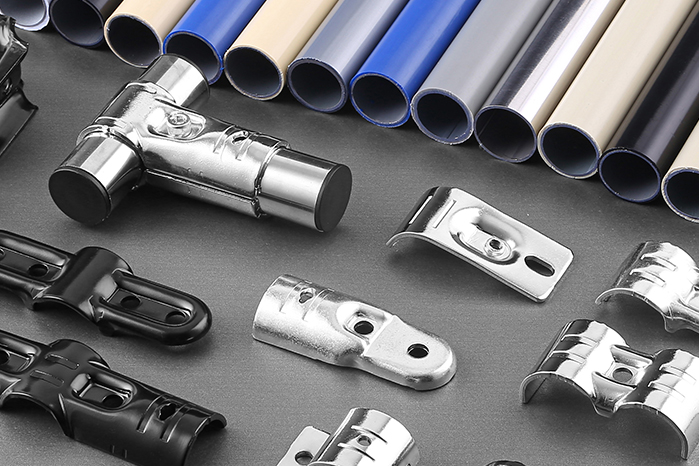
In contrast, lean pipe manufacturing utilizes cold-rolled steel tubes coated with plastic, as well as stainless steel tube options, secured by high-strength metal joints. This “Lego-like” assembly allows for immediate reconfiguration. Because the system relies on mechanical fastening rather than chemical bonding (welding), a workstation can be adjusted in minutes by a single technician with a basic hex wrench. This adaptability is the cornerstone of a “lean” facility, where the goal is to eliminate the eight wastes (DOWNTIME), specifically unnecessary motion and over-processing.
Technical Performance and Durability
A common misconception is that modular systems lack the durability of their welded counterparts. In reality, modern lean pipes are engineered for high-performance industrial use.
- Load Capacity: While welded racks excel in multi-ton pallet storage, lean tube systems are optimized for “line-side” logistics. High-quality lean pipes can easily support hundreds of kilograms per shelf when designed with proper triangulation.
- Surface Integrity: Welded racks are prone to rust at the joint sites if the paint chips. A premium lean pipe manufacturerutilizes PE (Polyethylene) or ABS coatings, which are resistant to chemicals, impacts, and corrosion.
- Maintenance: When a welded rack is damaged, the entire unit often needs to be taken offline and sent to a fabrication shop. With a modular system, a damaged tube or joint can be replaced individually, minimizing disruption to production.
Why Every Lean Pipe Manufacturer Prioritizes Modular Systems
For 2B businesses looking to optimize their ROI, the cost-benefit analysis of modular systems is compelling. Beyond the initial purchase price, one must consider the “total cost of ownership.” Traditional racks involve high labor costs for specialized welders and long lead times for off-site fabrication. Modular lean systems, however, empower internal maintenance teams to build, test, and iterate on designs immediately.
Customization and Integrated Logistics
The true power of the lean tube lies in its integration with gravity-fed logistics. Most modular systems are designed to work seamlessly with roller tracks, creating “flow racks” that ensure a First-In, First-Out (FIFO) inventory system. This is nearly impossible to implement effectively with static welded shelving. By using a modular approach, companies can create custom carts, kitting stations, and ergonomic workstations that are tailored to the specific height and reach of the operator, significantly reducing fatigue and increasing throughput.
Partnering for Industrial Excellence: The JunYi Advantage
As a professional lean pipe manufacturer, we understand that our 2B partners are not just looking for hardware; they are looking for a competitive edge in manufacturing efficiency. At JunYi, we specialize in providing comprehensive OEM and ODM services that bridge the gap between complex industrial requirements and simplified, modular execution.
We recognize that every facility has unique pain points. Whether you are in the automotive sector, electronics assembly, or pharmaceutical logistics, our engineering approach focuses on the “Lean” philosophy from the ground up. By choosing our solutions, you are not just buying pipes and joints; you are investing in a scalable infrastructure that grows with your business.
Our Commitment to Quality and OEM/ODM Innovation
At JunYi, we take pride in our role as a silent partner in your production success. Our manufacturing process utilizes advanced cold-rolling technology to ensure that every lean tube meets rigorous wall-thickness and coating-adhesion standards. Because we operate primarily in the 2B space, we have optimized our workflow to support large-scale industrial projects and specialized custom designs.
Our ODM services allow clients to request specific colors, coatings, and structural specifications that align with their brand’s internal 5S standards. We don’t just supply parts; we provide the building blocks for a more efficient future. By moving away from the static nature of traditional welded racks and embracing the modularity of our lean systems, your facility gains the “fluidity” required to survive in an era of rapid industrial change.
In conclusion, while traditional welded racks have their place in bulk, unchanging storage, the modern factory floor demands the agility provided by a dedicated lean pipe manufacturer. Through our expertise at JunYi, we provide the tools necessary to transform your workspace into a high-efficiency environment where waste is minimized, and productivity is maximized. Let us help you build a more flexible tomorrow—one joint and one tube at a time.