Moving fragile goods inside a factory can create a problem that is easy to overlook: the transport equipment itself may become a source of shock. Glass components, precision assemblies, finished products, and sensitive parts can be affected by repeated impacts from floor joints, thresholds, uneven surfaces, sudden starts, or abrupt stops. Choosing suitable industrial casters therefore requires more than checking load capacity.
At Junyi, we approach caster selection by looking at how the wheel interacts with the floor and how that interaction affects the transported load. Our caster range includes PU, TPR, rubber, PVC, nylon, and other wheel options designed for different material-handling conditions.
Why Fragile Loads Experience More Damage During Movement
A cart does not travel across a perfectly smooth surface. Factory floors contain expansion joints, small gaps, ramps, transitions, and areas with different surface conditions. Each irregularity can create a short impact as the wheel passes over it.
Rigid wheels tend to transfer more of that disturbance into the cart structure. A fragile product may then experience vibration or acceleration that is undesirable even though the total load remains within the rated capacity of the equipment.
Wheel elasticity changes this interaction. Softer materials can deform slightly as they encounter an obstacle, creating a more gradual contact event. That does not eliminate every vibration source, but it can change how the disturbance reaches the frame and payload.
The same principle applies during starts and stops. A cart carrying delicate products can experience repeated dynamic forces if operators accelerate quickly or brake abruptly. Caster selection should therefore consider movement behavior, not only static weight.
How Wheel Construction Changes Shock Transmission
Material is one of the first variables to examine. The caster range listed by Junyi includes PU, TPR, rubber, PVC, PA, and ESD-related options, showing that wheel construction can be matched to different operating requirements.
Rubber and elastic wheel materials can be useful where reducing transmitted vibration is a priority. TPR options may also suit environments where quieter, smoother movement is desirable. PU provides another route when users need a balance between resilience and industrial handling requirements.
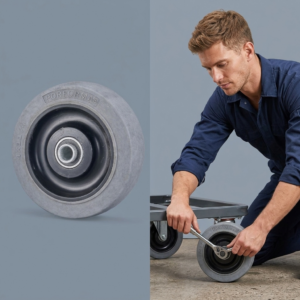
Wheel construction matters alongside material. At Junyi, our range includes double-bearing PU models, aluminum-core PU wheels, iron-core PU wheels, and elastic rubber designs. These configurations demonstrate why two wheels made from broadly similar materials can behave differently under load.
Wheel diameter also deserves attention. A larger wheel can generally pass over small floor irregularities more easily than a small wheel, reducing the severity of some obstacles. Yet diameter should be selected together with available clearance, cart dimensions, load requirements, and maneuverability.
Match the Caster to the Transport Environment
The right casters industrial solution starts with the route rather than the product catalog. Map the actual path used by the cart. Note floor joints, ramps, thresholds, turning areas, surface transitions, and sections where debris may accumulate.
Next, identify how the cart is handled. A manually pushed cart has different operating behavior from equipment that is pulled or integrated into a material-flow system. Frequent starts, stops, and directional changes can make wheel characteristics more important.
Payload distribution is equally significant. A fragile product placed high above the caster mounting points can respond differently to impacts than a low, evenly distributed load. Uneven loading may also increase vibration or make the cart less stable.
Environmental requirements should remain part of the decision. Anti-static rubber, for example, appears within Junyi’s caster range, while different PU, PVC, TPR, nylon, and rubber models provide options for varying factory conditions. The objective is not to select the softest wheel available, but to match the wheel to the complete operating environment.
Design the Cart Around the Shock-Absorption Requirement
Replacing wheels alone may not solve every transport problem. A caster works as part of a larger mechanical system that includes the frame, mounting plate, fasteners, shelves, and payload support.
Cart rigidity can influence how vibration travels through the structure. A poorly distributed load may create movement even if the selected wheel has suitable elastic characteristics. Mounting quality matters too. Loose or incorrectly fitted casters can introduce unwanted movement and noise.
Wheel arrangement should reflect how the cart turns and moves. Swivel casters can improve maneuverability, while fixed configurations can support directional travel. The best arrangement depends on the route and handling method rather than a universal formula.
We recommend evaluating the complete cart under representative conditions. Load the equipment with a realistic payload and move it across the actual floor route. Observe how the cart responds to thresholds, turns, acceleration, and stopping. This practical test can reveal issues that a specification sheet cannot.
Turn Caster Selection Into a Transport-Control Strategy
For fragile goods, industrial casters should be treated as part of the product-protection system. The objective is not simply to make a cart easier to push. It is to control the mechanical disturbances introduced during internal transportation.
A useful selection sequence begins with the payload, followed by route conditions, operating speed, wheel material, wheel construction, caster arrangement, and mounting method. Each factor should support the same transport objective.
Buyers should also compare the actual caster designs rather than selecting only by wheel material. We at Junyi offer multiple configurations, including PU wheels with different cores and surfaces as well as elastic rubber and TPR options. Such variation gives manufacturers more room to match the caster to a specific handling scenario.
The phrase casters industrial should therefore describe a functional selection, not simply a product category. Fragile-goods transport benefits when the wheel, cart, payload, and route are considered as one system.
Protect the Load by Controlling the Journey
Fragile goods do not become safer simply because a cart has enough load capacity. Repeated small impacts can matter just as much as the headline weight rating. Wheel elasticity, construction, diameter, cart design, and route conditions all influence the way those disturbances reach the payload.
We focus on matching caster characteristics with real factory requirements instead of treating every transport cart the same. That approach makes industrial casters a practical component of material-handling design, particularly where reducing unnecessary shock and vibration is central to product protection.
For B2B buyers, the strongest decision comes from testing the complete cart on its actual route. A caster that performs well under representative conditions can contribute to smoother movement, better handling control, and a more suitable transport system for fragile goods.