When evaluating bearings for industrial casters, many buyers fixate on line speed. But a cart moving at 5 mph with a 4-inch wheel generates a very different bearing RPM than one with an 8-inch wheel. That difference changes the bearing selection entirely.
The same line speed can mean twice the rotational speed for a smaller wheel, and that higher RPM produces more heat, more friction, and faster grease breakdown. So before comparing bearing types, the evaluation must account for the actual operating envelope—not just a speed label.
Why Wheel RPM Matters More Than Line Speed
Line speed is a convenient shorthand, but it is not the primary stressor on a bearing. Bearing life is determined by revolutions per minute, load, and lubrication. A wheel turning at 200 RPM experiences far more wear cycles per hour than one turning at 100 RPM, regardless of whether the cart travels the same distance. That is why two casters rated for “high speed” can perform completely differently in the same application.
Wheel diameter directly converts line speed into RPM. Smaller wheels spin faster at any given travel speed. For powered applications that may reach 8–10 mph or higher, a small-diameter wheel can push bearing RPM into a range where standard grease fails and clearance tolerances become critical.
In addition to RPM, consider the duty cycle—continuous running versus intermittent use—and the ambient temperature, which affects grease viscosity. Surface conditions and wheel material also influence shock loads that transmit through the bearing. A comprehensive evaluation must include all these variables, not a single speed threshold.
Precision Ball Bearings — The Choice for Consistent High-Speed Rolling
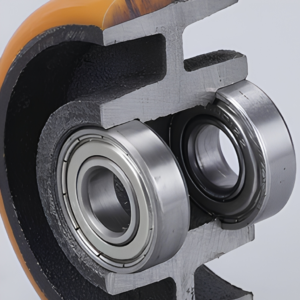
Precision ball bearings, specifically deep-groove designs, are the standard choice for applications that demand sustained high RPM with minimal side thrust. They offer the lowest internal friction of any caster bearing type, which translates to cooler operation at speed.
The sealed versions—double-sealed with steel-reinforced rubber—keep contaminants out and retain grease effectively, extending service intervals in dusty or wet environments.
However, precision ball bearings have a limitation: they handle radial loads well but are not designed for significant side thrust. When specifying our industrial casters at Junyi for demanding material-handling applications, we consider bearing selection together with wheel diameter, load, and turning conditions. A caster used on uneven floors or with frequent directional changes may experience greater lateral forces, making the overall caster configuration just as important as the bearing type.
If industrial casters and wheels operate on uneven floors with frequent turns, the lateral forces can overload the bearing raceways. In such cases, a higher load-rated ball bearing or a different bearing type may be required.
Also note that bearing size matters—a larger-diameter ball bearing of the same type can sustain higher RPM because the rolling elements are larger and dissipate heat better. Always match the bearing size to the wheel diameter and the expected load, not just the speed rating on the datasheet.
Tapered Roller Bearings — When Side Thrust Joins the Equation
When high RPM coincides with substantial side thrust—from aggressive turning, powered towing, or uneven terrain—tapered roller bearings become the appropriate selection. Their conical geometry enables them to manage both radial and axial loads simultaneously, making them ideal for extreme-capacity applications that involve continuous operation and frequent directional changes.
The trade-offs are real. Tapered bearings require regular maintenance, including periodic adjustment and relubrication. They generate more rolling resistance and more noise than precision ball bearings. They also cost more upfront. So the decision is not simply “tapered is better.”
Choose tapered bearings only when the operating profile includes both sustained high RPM and significant side thrust. For straight-line, high-speed conveying with minimal turning, precision ball bearings will outlast and out-perform tapered rollers while requiring less attention.
Three Bearing Types to Eliminate Immediately
Three common bearing types should be ruled out without hesitation when RPM and duty cycle are elevated.
Plain bores — simple bushings with no rolling elements. They rely on sliding friction and generate excessive heat at speed. They are acceptable for light-duty, infrequent movement at walking pace, but they fail rapidly in continuous high-RPM applications.
Roller bearings (needle bearings) — despite their high radial load capacity, they have higher internal friction than ball bearings and are not designed for sustained high RPM. They perform well in manual carts moved intermittently, but continuous rotation at speed leads to premature wear and increased rolling resistance.
Delrin bearings — plastic bushings that offer chemical resistance and zero maintenance, but they have poor heat dissipation and limited load capacity. They soften under sustained friction and are unsuitable for any application involving elevated RPM or heavy loads.
Eliminate these three, and the evaluation narrows to precision ball bearings and tapered roller bearings. The remaining choice depends entirely on side thrust and maintenance tolerance.
The Swivel Head Bearing — A Separate but Critical Evaluation
Industrial casters and wheels contain bearings in two places: the wheel hub and the swivel head. The swivel head bearing allows steering, and in high-RPM applications, it experiences constant rotation as the cart changes direction. A high-quality wheel bearing paired with a poor swivel head bearing will still fail.
For high-RPM operation, specify a sealed swivel head bearing with a hardened raceway. Sealing prevents debris ingress, which is critical when the caster rotates frequently.
Hardened raceways resist brinelling from shock loads. Some manufacturers offer double-ball swivel designs that improve load distribution and smoothness during directional changes. Do not overlook this component—it is as important as the wheel bearing, and it should be evaluated with the same RPM and load criteria.
Making the Final Decision — A Multi-Factor Framework
The correct bearing type emerges from a weighted assessment of five parameters: wheel diameter (determines RPM at your line speed), radial load (vertical weight), side thrust (lateral forces from turning), duty cycle (continuous or intermittent), and operating environment (temperature, moisture, debris).
Start by calculating the actual wheel RPM from your maximum line speed and wheel diameter. Then estimate the side thrust based on turning radius and load. Next, assess the duty cycle—if the caster runs for hours without rest, sealed precision ball bearings with high-temperature grease are preferable; if the cycle is shorter or intermittent, tapered bearings become more viable.
At Junyi, we offer heavy-duty, medium-duty, and light-duty casters with different wheel materials and configurations for specific load and operating conditions. For heavy material-handling carts, our heavy-duty caster options provide a more suitable starting point where high load capacity, durability, and stable rolling are required.
Wheel materials such as rubber, TPR, PU, PVC, and conductive compounds can also be selected according to floor conditions, noise requirements, wear resistance, and static-control needs. This allows the caster configuration—not just the bearing or speed rating—to be matched to the cart’s actual working environment.
That approach eliminates guesswork and reduces field failures. For most straight-line, continuous high-RPM applications, we specify double-sealed precision ball bearings. For powered tugs with tight turns and heavy loads, we recommend tapered rollers with a scheduled maintenance plan. And we always check the swivel head—sealed and hardened, every time.
The evaluation is not about picking the “best” bearing type in isolation. It is about matching the bearing’s strengths to the actual operating conditions. Line speed alone is a weak signal.
RPM, load, thrust, cycle, and environment—these are the real decision drivers. Apply them consistently, and your industrial casters and wheels will perform reliably at any speed your operation demands.