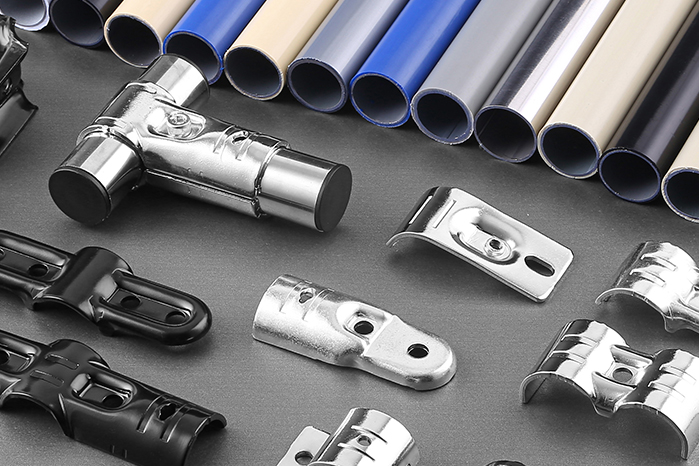
In the architecture of modern industrial logistics, the strength of a structure is entirely dependent on its weakest point. For high-capacity storage, heavy-duty kitting carts, and gravity-fed flow racks, that point is the mechanical connection. The metal pipeline joint serves as the critical nexus where structural integrity meets modular flexibility. For 2B procurement officers and plant engineers, selecting a joint that can withstand the rigors of heavy-duty manufacturing is not just a matter of “building a rack”—it is about ensuring the safety of the workforce and the continuity of the production line.
As global manufacturing shifts toward more dense and high-output environments, the demand for tube and joint systems that can support hundreds of kilograms per square meter has intensified. Unlike standard residential or light-commercial connectors, industrial-grade metal joints must be engineered with specific mechanical features that allow them to endure constant shear, compression, and vibrational stress.
- High-Tensile Cold-Rolled Steel Construction
The foundation of any heavy-load metal pipeline joint is its material composition. Industrial joints are typically manufactured from high-grade cold-rolled steel. The cold-rolling process increases the yield strength of the metal, allowing the joint to maintain its shape even when under extreme pressure. This is essential for preventing “permanent deformation,” where a joint bends or warps over time, leading to the gradual collapse of the rack.
- Multi-Point Contact and Friction Architecture
A joint does not hold onto a pipe through adhesive; it holds through friction. For heavy-load applications, the interior geometry of the joint must be precision-engineered to maximize surface contact with the pipe.
Advanced joints feature a “wraparound” design that ensures pressure is distributed evenly across the circumference of the tube. This prevents localized crushing of the pipe and ensures that the joint will not slide vertically, even when the structure is loaded with heavy automotive parts or bulk chemical containers.
- Precision Stamping for Wall Thickness Consistency
In the 2B sector, the thickness of the joint’s steel wall is a non-negotiable specification. A high-performance metal pipeline joint typically features a wall thickness of 2.5mm. This thickness provides the necessary rigidity to handle the torque required to tighten the fastening bolts. If the metal is too thin, the joint will “flare” or open up during tightening, compromising the security of the connection. Precision stamping ensures that this thickness is uniform throughout the entire part, eliminating weak spots.
- High-Torque Fastening Systems
The efficiency of tube and joint systems depends on the hardware that holds them together. Heavy-load joints utilize M8 or higher-grade high-tensile bolts and nuts. These fasteners are designed to be tightened to a specific Newton-meter (Nm) rating that provides maximum “bite” on the pipe without stripping the threads. In heavy-duty environments, the nut is often integrated into a recessed pocket within the joint to prevent it from loosening due to the vibrations of nearby factory machinery.
- Advanced Surface Treatment for Industrial Durability
Heavy loads often exist in harsh environments. Whether it is a humid warehouse or a chemical-rich assembly floor, the joint must be protected from corrosion. Industrial joints are treated with specialized finishes:
- Black Electrophoresis: Provides a high-adhesion, rust-resistant layer that is ideal for standard automotive assembly.
- Chrome Plating: Offers a hard, wear-resistant surface that maintains its integrity even in high-friction or high-cycle environments.
- Zinc Plating: A traditional yet effective barrier against oxidation for long-term storage applications.
- Ergonomic and Safe Edge Profiling
Safety is a critical feature of any 2B hardware. Heavy-duty joints are designed with rounded edges and deburred surfaces. This prevents injury to operators during the assembly process and ensures that the joints do not catch on clothing or skin in high-traffic areas. Furthermore, a flush-fit design ensures that the joint does not protrude excessively, allowing for tighter configurations in space-constrained facilities.
Engineering Strength: The JunYi Approach to Heavy-Duty Connections
At JunYi, we recognize that our partners in the 2B space cannot afford to gamble on structural integrity. We understand that when you are building a system to transport a 500kg engine block or store high-value electronics, the metal pipeline joint is the most important component in your facility. As a dedicated manufacturer, we have built our reputation on the relentless pursuit of structural excellence.
Our manufacturing philosophy is rooted in the “Science of Lean,” which means removing the waste of failure. By focusing on the precision of our metal joints, we ensure that your facility remains stable, safe, and efficient. We don’t just supply parts; we supply the peace of mind that comes from knowing your infrastructure is built to a global industrial standard.
The JunYi Technological Advantage
Our commitment to quality is supported by our specialized production capabilities. According to our Technology Advantages, we utilize automated precision stamping and advanced heat-treatment processes to ensure that every metal pipeline joint we produce is identical to the last. We recognize that consistency is the foundation of a 2B partnership.
We prioritize the use of high-grade 2.5mm cold-rolled steel in our heavy-duty lines. This ensures that our tube and joint systems can handle the dynamic loads of a 24/7 manufacturing environment. Our joints are engineered to maintain their grip through hundreds of thousands of vibration cycles, making them the ideal choice for Tier-1 automotive suppliers and global logistics providers.
Tailored OEM/ODM Solutions for Global Industry
We understand that “heavy load” means something different to every client. Some require joints that can withstand the high-temperature environment of a curing oven, while others need ESD-safe connections for sensitive micro-chip assembly. This is why JunYi offers comprehensive OEM and ODM services.
Our engineering team works as an extension of your own, helping you design custom joint configurations that meet your specific structural and environmental requirements. We provide the technical specifications, load-bearing data, and material certifications necessary to satisfy your internal safety audits. By choosing us as your manufacturing partner, you are choosing a company that understands the mechanics of success.
In conclusion, the right metal pipeline joint is a sophisticated piece of industrial engineering. By selecting components that prioritize wall thickness, friction architecture, and material grade, you can build a modular system that is as strong as a welded structure but far more flexible. At JunYi, we are proud to provide the joints that hold the modern industrial world together.