In the modern industrial landscape, the static warehouse is a relic of the past. To maintain a truly lean operation, infrastructure must be as mobile as the inventory it carries. This mobility is facilitated by the integration of industrial casters into modular racking systems, allowing for the rapid reconfiguration of assembly lines and the seamless transport of “kits” from the warehouse to the production floor. However, when dealing with the high-mass loads typical of automotive, aerospace, and heavy machinery sectors, the selection and maintenance of heavy duty casters become critical safety and efficiency factors.
For 2B facility managers, the “set and forget” mentality can be dangerous. Implementing a mobile lean system requires a technical understanding of load distribution, floor interface, and ergonomic drag. By following established best practices, enterprises can ensure that their mobile racks remain a high-performance asset rather than a workplace hazard.
Calculating the True Load Capacity
The most frequent mistake in implementing mobile racking is underestimating the “total dynamic load.” When a rack is stationary, the weight is distributed evenly. However, when that rack is put into motion, the center of gravity shifts, and a single caster may momentarily bear a disproportionate amount of the weight.
To calculate the required capacity for heavy duty casters, the industry standard is the “Safety Quotient” formula. If you are building a four-wheeled cart, you should calculate the load capacity based on the strength of only three wheels. This accounts for uneven floor surfaces where one wheel may momentarily lose contact, shifting the entire weight onto the remaining three. Furthermore, the weight of the tube and joint systems framework itself must be added to the maximum projected weight of the inventory to find the true gross vehicle weight.
Material Selection and Floor Protection
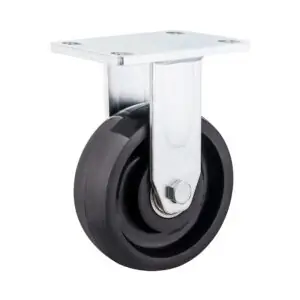
The material of the caster wheel dictates both the ease of movement and the longevity of the facility floor. In heavy-duty 2B environments, two materials dominate:
- Polyurethane on Iron: These are the workhorses of the industrial world. They offer high load capacities while providing a slight “give” that protects epoxy-coated floors and reduces noise.
- Nylon or Hard Plastic: Ideal for extremely heavy loads where the rack will remain stationary for long periods. These materials resist “flat-spotting,” which occurs when a softer wheel deforms under a static load over time.
Selecting the right material reduces the “initial push force”—the amount of energy an operator (or an AGV) must exert to break static friction. Reducing this force is a core tenet of lean ergonomics, as it prevents long-term strain injuries and minimizes power consumption for automated tuggers.
Configuration: Swivel vs. Rigid
The maneuverability of a lean rack is determined by its caster configuration. For tight assembly environments, a “Diamond” or “Four-Swivel” setup is often preferred.
- Four Swivel Casters: This allows for 360-degree rotation and sideways movement, which is essential for placing racks into narrow “strike zones” along a production line.
- Two Swivel, Two Rigid: This “shopping cart” configuration is best for long-distance transport through warehouse aisles, as the rigid casters provide directional tracking and prevent the cart from “fishtailing” during transport.
Engineering Mobility: The JunYi Advantage
At JunYi, we recognize that a lean racking system is only as good as its ability to move when and where it is needed. As a dedicated manufacturer and B2B partner, we provide the hardware that bridges the gap between static storage and dynamic flow. We understand that in an OEM/ODM partnership, our clients require casters that are engineered for the same high-cycle durability as our pipes and joints.
Our approach to industrial casters is rooted in the “Science of Lean.” We focus on reducing the waste of motion by providing high-precision bearings and durable housing designs that ensure a smooth roll every time. We don’t just supply wheels; we supply the foundation of your facility’s agility.
Precision Performance: Our Heavy Duty Caster Catalog
Our commitment to quality is reflected in our diverse product line. We offer a range of solutions tailored to specific industrial load profiles. We prioritize the use of high-grade steel in our caster brackets and precision-sealed ball bearings in the swivel heads. This ensures that even under maximum load, the rack remains easy to steer. For our 2B clients, this means a lower Total Cost of Ownership (TCO), as our casters are built to resist the dust, metal shavings, and floor debris common in manufacturing environments, preventing the premature bearing failure that plagues lower-tier hardware.
Tailored OEM/ODM Mobility Solutions
Every production floor has its unique challenges—some require non-marking wheels for cleanroom environments, while others need heat-resistant materials for racks that pass through curing ovens. At JunYi, we leverage our manufacturing expertise to provide custom ODM solutions for these specific needs.
We work closely with your engineering teams to provide the load-bearing data and technical specifications required for safety audits. Whether you are outfitting a new Tier-1 automotive facility or optimizing a pharmaceutical distribution center, our goal is to provide the “invisible reliability” that keeps your operation moving. By choosing us as your partner, you are investing in a mobile infrastructure that is designed to grow, adapt, and perform under the most demanding conditions.
In conclusion, implementing heavy duty casters is a strategic decision that affects the safety and efficiency of your entire facility. By adhering to best practices in load calculation and material selection, and by partnering with a manufacturer that understands the rigors of the 2B sector, you can transform your lean racking into a truly dynamic asset. Let us help you put your efficiency in motion.