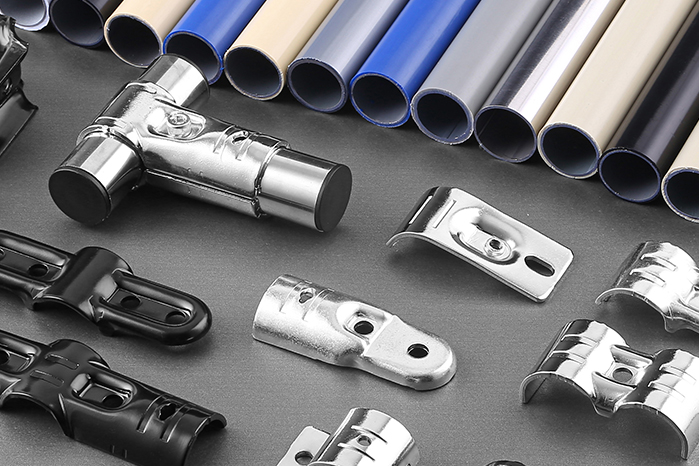
In the specialized world of 2B industrial logistics, the efficiency of a production facility is often determined by the smallest components. While the primary framework of a modular system is built on steel tubing, the true performance is dictated by the selection of lean hardware accessories. For procurement managers and industrial engineers, selecting these components is not merely a purchasing task; it is an engineering decision that impacts the safety, scalability, and structural integrity of the entire plant floor.
As manufacturing cycles become shorter and the need for “Kaizen” (continuous improvement) grows, the ability to identify high-quality hardware becomes a competitive advantage. Selecting the wrong accessory can lead to structural sagging, joint slippage, or even costly downtime. To build a system that lasts, one must evaluate hardware through the lens of material science, load dynamics, and environmental compatibility.
Evaluating Material Grade and Surface Treatment
The first step in selecting lean hardware accessories is understanding the environment where they will be deployed. Not all steel is created equal, and the finish of a component determines its resistance to the rigors of the factory floor.
- Strength Requirements: For heavy-duty applications, such as engine kitting carts or bulk material flow racks, accessories must be manufactured from high-grade cold-rolled steel. This ensures that the hardware maintains its shape under high torque and constant weight.
- Corrosion Resistance: In facilities that utilize chemical cleaners or operate in high-humidity zones, the surface treatment is paramount. Chrome plating offers a high-hardness finish suitable for friction-heavy areas, while black electrophoresis provides a cost-effective, rust-resistant coating for standard assembly environments. For cleanroom or pharmaceutical applications, stainless steel accessories are the industry standard to prevent any risk of oxidation or contamination.
Compatibility and Dimensional Precision
A modular system is only as strong as its tightest connection. When sourcing a lean pipe joint, precision in the stamping and molding process is critical. If a joint is even a fraction of a millimeter off in its diameter, the “grip” on the pipe will be compromised.
When evaluating suppliers, it is essential to check for “clamping force.” A high-quality accessory should wrap around the pipe with 100% surface contact. This even distribution of pressure prevents the pipe from “creeping” or rotating over time—a common failure in systems that use low-quality, thin-gauge hardware. Furthermore, ensure that the bolts and nuts provided with the accessories are of a high-tensile grade (such as 8.8 grade or higher) to prevent stripping during the high-torque tightening required for industrial stability.
The Strategic Value of Modular Design
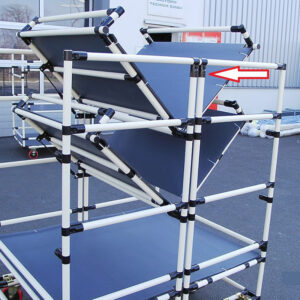
The selection of hardware should also be guided by the “Speed of Reconfiguration.” The primary goal of lean manufacturing is to eliminate waste, and that includes the time spent by maintenance teams building or adjusting racks. Hardware that requires complex tools or multiple operators to install is a form of hidden waste. The best accessories are those that allow a single technician with a standard 5mm or 6mm hex wrench to make on-the-fly adjustments to a workstation’s height or a flow rack’s incline.
Engineering Reliability: The JunYi Standard
At JunYi, we understand that our 2B partners are looking for more than just parts; they are looking for “invisible” reliability. As a dedicated manufacturer of modular systems, we have spent years refining our production of lean hardware accessories to meet the uncompromising standards of the global automotive, electronics, and logistics sectors.
We recognize that in an OEM or ODM partnership, consistency is the foundation of trust. If a manufacturer receives ten thousand joints, every single one must perform identically to the first. This is why we utilize automated precision stamping and rigorous quality control protocols. When we talk about our role in your supply chain, we view ourselves as the backbone of your facility’s agility.
Precision at the Core: The JYJ-1 Lean Pipe Joint
A prime example of our commitment to engineering excellence is the JYJ-1 lean pipe joint. As the most fundamental and versatile connector in our catalog, the JYJ-1 is designed to provide a rock-solid T-junction between two pipes.
Constructed from 2.5mm thick cold-rolled steel, the JYJ-1 offers superior structural rigidity compared to the 2.0mm alternatives often found in the market. This extra thickness ensures that the joint does not “flare” or deform when tightened to the necessary torque levels. Its design features a specialized inner-wall texture that bites into the pipe coating, providing a high-friction bond that is essential for vertical load-bearing applications.
For our 2B clients, the JYJ-1 represents the gold standard of lean pipe joint technology. Whether you are building a custom packing station or a complex Karakuri gravity-feed system, the JYJ-1 ensures that your structure remains “square” and stable, even under the constant vibration of a busy production line. It is a testament to our belief that the best hardware is that which you can install and never have to think about again.
Your Partner in Industrial Customization (OEM/ODM)
We know that every factory has unique pain points. Some require ESD-safe (Electrostatic Discharge) accessories for sensitive semiconductor assembly, while others need heavy-duty, reinforced hardware for Tier-1 automotive logistics. At JunYi, we specialize in providing tailored solutions.
Our ODM services allow us to collaborate with your engineering teams to develop specialized lean hardware accessories that fit your specific load profiles or environmental constraints. We don’t just provide the components; we provide the technical expertise to ensure your modular system is optimized for its specific “Use Case.”
By choosing to partner with us, you are investing in a manufacturing ally that prioritizes durability, precision, and the relentless pursuit of waste reduction. We are here to help you select the hardware that will carry your business through the next decade of industrial evolution.