In the industrial sector, the lifespan of a facility’s infrastructure is often dictated by its resistance to environmental stressors. For factories operating in high-humidity regions, chemical processing plants, or facilities with frequent wash-down requirements, the standard steel pipe is a liability. Oxidation—commonly known as rust—is not merely a cosmetic issue; it is a structural failure that can lead to contamination, reduced load-bearing capacity, and the eventual collapse of modular racking systems. Selecting the correct anti rust pipe is a fundamental engineering decision that balances material science with long-term capital expenditure.
The Chemistry of Corrosion: Why Standard Steel Fails
To understand the necessity of specialized piping, one must first look at the science of oxidation. When raw steel is exposed to oxygen and moisture, an electrochemical reaction occurs, creating iron oxide. In an industrial setting, this process is accelerated by “catalysts” such as salt in coastal areas, acidic vapors in chemical plants, or even the microscopic particles of dust that trap moisture against the pipe’s surface.
Once corrosion begins, it is “autocatalytic,” meaning the rust itself holds moisture and promotes further oxidation deeper into the metal. For 2B enterprises, this leads to “pitting” and structural thinning. If a pipe is part of a gravity flow rack or a heavy-duty workstation, a mere 10% reduction in wall thickness due to rust can lead to a disproportionate drop in safe load capacity, creating a significant safety hazard for floor operators.
Comparing Anti-Corrosion Methodologies
There are several technical approaches to achieving a corrosion resistant pipe status, each suited to different industrial “micro-climates.”
- Stainless Steel (304/316 Grade): These pipes contain high levels of chromium and nickel, which form a self-healing passive layer. While extremely effective, they are often cost-prohibitive for large-scale modular racking and do not always provide the specific “grip” required for plastic or metal joints.
- Galvanized Coating: This involves dipping the steel in molten zinc. The zinc acts as a sacrificial anode, corroding before the steel does. However, if the zinc layer is scratched during assembly or reconfiguration, the underlying steel remains vulnerable.
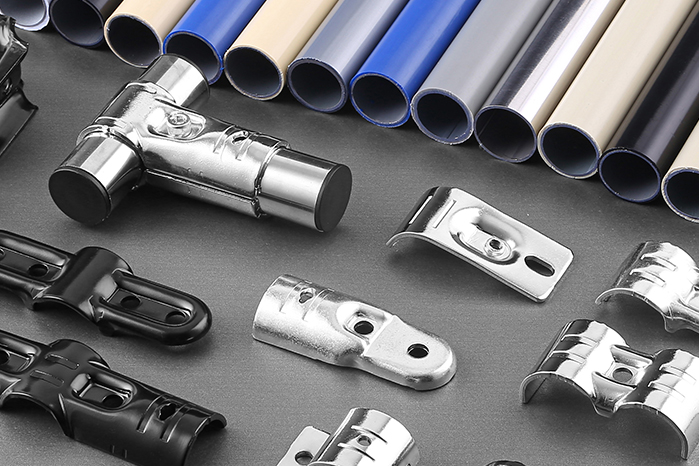
- Advanced Polymer Coating (Coated Pipe): This is the modern standard for “Lean” manufacturing. A high-strength cold-rolled steel pipe is encased in a thick, uniform layer of thermoplastic or specialized resin. This creates a physical barrier that is 100% impermeable to moisture and most industrial chemicals.
The Technical Advantage of Coated Structural Pipes
The use of an anti rust pipe featuring an external polymer coating offers more than just chemical resistance. In a popular science context, these coatings provide “vibration dampening” and “thermal insulation.” Because the polymer layer is non-reactive, it prevents the “cold-welding” effect that sometimes occurs between metal joints and metal pipes in humid environments, ensuring that the system remains modular and can be disassembled years later without the need for cutting tools.
Furthermore, these pipes are often treated internally with anti-corrosion oils or coatings, ensuring that the pipe does not rot from the inside out—a common failure point in facilities with high temperature fluctuations that cause internal condensation.
JunYi: Your Global Partner for High-Performance Coated Solutions
At JunYi, we specialize in the engineering and manufacturing of structural components designed to survive the harshest 2B industrial environments. We understand that for our partners—ranging from automotive assembly integrators to international logistics providers—the reliability of the “skeleton” of their facility is paramount.
Our flagship anti rust pipe series is engineered specifically for modularity and longevity. We utilize a sophisticated multi-stage manufacturing process that ensures our corrosion resistant pipe products exceed standard industrial requirements. As an OEM and ODM powerhouse, we maintain strict control over the bonding process between the steel substrate and the protective outer layer.
Why Choose JunYi for Your OEM/ODM Requirements?
As a dedicated manufacturer, we go beyond simply providing materials. We offer specialized solutions tailored to your factory’s specific “threat profile.”
- Customized Coatings: If your facility handles sensitive electronics, we provide anti-static (ESD) coated pipes that prevent static buildup while offering the same high-level rust protection.
- Consistency at Scale: Through our advanced extrusion lines, we ensure that the coating thickness is uniform across every millimeter of the pipe. This ensures that our metal joints fit perfectly every time, preventing the gaps where moisture often hides in inferior systems.
- B2B Durability: Our anti rust pipe is tested for impact resistance. Unlike paint, which chips, our polymer coating is resilient to the “bumps and bruises” of a busy factory floor, maintaining its protective seal even after accidental contact with carts or tools.
In the world of 2B industrial supply, the goal is to build once and move forward. By integrating JunYi corrosion-resistant solutions into your facility, you are eliminating the “rust tax”—the hidden costs of maintenance, replacement, and downtime. We invite you to explore our full catalog of coated solutions and discover why leading global manufacturers rely on our structural integrity to power their lean operations.