A factory cart with a failed caster is not a minor inconvenience. It is a stopped workflow. A damaged floor. A safety hazard. And often, it is the result of a selection decision made too quickly.
The wrong heavy-duty industrial casters do not just wear out—they can fail unpredictably. Wheels can develop flat spots. Brackets can bend. Bearings can seize. And the cart becomes immovable in the middle of a production aisle.
This guide walks through the selection decisions that actually matter for factory cart applications. This guide focuses on the criteria that determine whether your casters last for years or only for weeks.
Why Factory Cart Casters Fail Prematurely
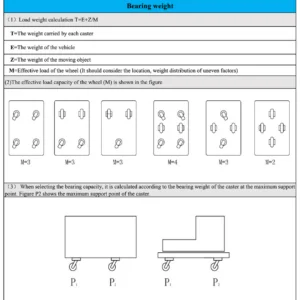
The most common failure mode is not overloading—it is uneven loading. A four-caster cart rarely distributes weight evenly across all four wheels. Floor imperfections, slight frame twists, and ramp transitions mean that at any given moment, only three casters carry the full load.
This is why dividing total weight by four is a mistake. Divide by three instead, then add a safety margin. A caster rated exactly at one-quarter of the total load will be under-specified in real operating conditions.
The second failure mode is material mismatch. A rubber wheel on a rough concrete floor wears down in weeks. A nylon wheel on a delicate epoxy floor leaves marks and creates rolling resistance. The material must match the surface.
Start with Load, but Do the Math Right
Load calculation follows a simple formula, but the assumptions matter.
Step 1 — Total mass: Add the empty cart weight plus the maximum payload. Be honest about maximum—operators will overload carts.
Step 2 — Safety factor: Choose between 1.3 and 2.0. Use the higher end for carts that encounter floor joints, ramps, impacts, or forklift pushing. Factory carts rarely travel on perfectly smooth, perfectly flat floors.
Step 3 — Effective casters: On a four-caster cart, assume only three carry the load at any time. This accounts for real-world floor conditions.
Step 4 — Per-caster rating: Multiply total mass by the safety factor, then divide by the effective caster count.
Example: A 600 kg payload on an 80 kg cart totals 680 kg. With a 1.5 safety factor and three effective casters, each caster needs a minimum dynamic rating of 340 kg. Choose the next rating up—400 kg or higher—to add margin for wear.
If your cart travels faster than 4 km/h or operates continuously, derate the dynamic capacity by 10 to 30 percent. Heat builds in the tread and grease, reducing the real-world capacity.
Wheel Material Is a Trade-Off, Not a Preference
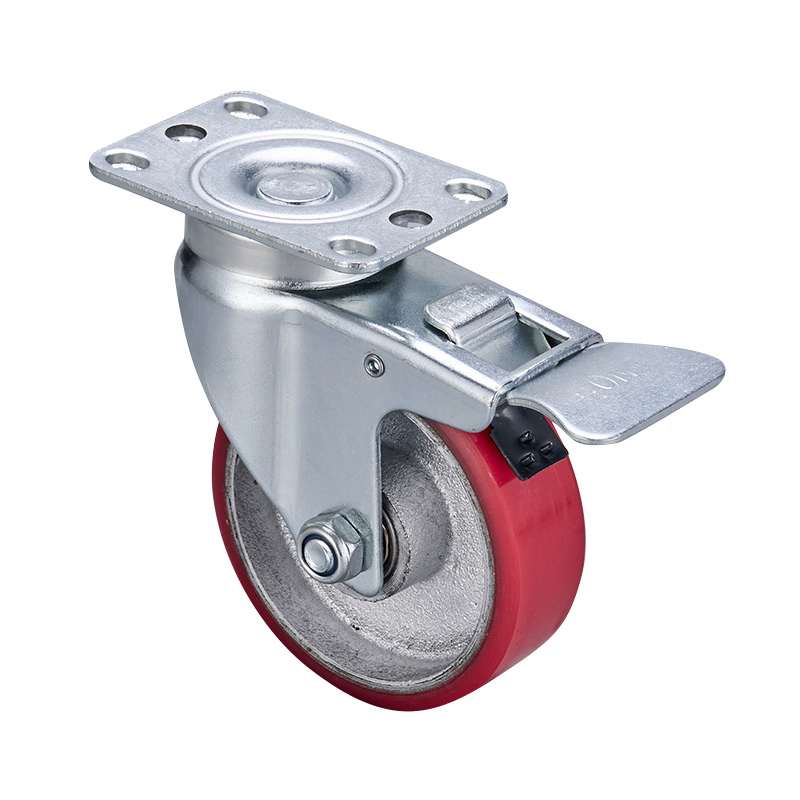
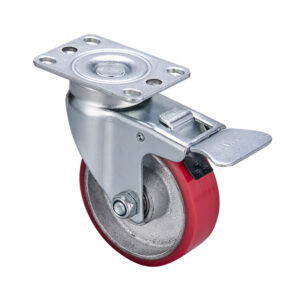
Polyurethane (PU) is the most popular choice for heavy duty industrial casters in factory settings. It combines high load capacity, quiet operation, floor protection, and excellent wear resistance. PU wheels carry heavier loads than rubber while remaining gentler on floors than nylon or cast iron.
For rough concrete floors, a higher-durometer PU holds up better. For tile or epoxy floors, a softer PU reduces marking and improves traction.
Nylon (PA6) offers very high load capacity and low rolling resistance. It excels in chemical environments and on smooth concrete. But nylon is noisier and harsher on delicate floors. Use it where floor protection is secondary to durability.
Rubber provides quiet movement, shock absorption, and better grip on uneven surfaces. However, rubber has lower load capacity than PU or nylon. It is best for noise-sensitive environments or mixed indoor surfaces.
Cast iron is for extreme applications—steel fabrication, high-temperature areas, and very heavy machinery movement. It is strong, heat-resistant, and impact-resistant, but it damages floors.
The floor surface is the deciding factor. Smooth concrete works with PU or nylon. Rough or uneven surfaces need larger-diameter PU or rubber wheels to absorb shock. Epoxy or delicate floors demand soft PU to reduce marking.
Size, Mount, Swivel, Brake — The Four Configuration Decisions
Wheel diameter is often underestimated. Larger wheels roll more easily and cope better with floor joints, debris, uneven surfaces, and expansion gaps. Smaller wheels may technically support the load but require significantly more force to move.
For factory carts, 150mm to 200mm wheels are typical for heavy-duty applications. Larger diameters reduce operator effort and extend caster life.
Mounting type depends on your cart frame. Top plate mounting is the most common for factory carts, with bolt patterns that match the cart’s mounting pads. Stem mounting suits specific equipment types. Confirm the mounting interface before ordering.
Swivel versus rigid determines maneuverability. Swivel casters rotate 360 degrees for maximum maneuverability. Rigid casters track in a straight line. Most factory carts use two swivel casters at the front and two rigid casters at the rear. For long carts, a six-caster layout—two rigid in the center plus four swivel at the corners—improves tracking and maneuverability.
Brakes keep carts stationary when needed. Total-lock brakes lock both the wheel and the swivel mechanism. Side brakes lock only the wheel. For factory carts that park on inclines or near production equipment, total-lock brakes provide the most security.
Putting It All Together for Your Factory Carts
Industrial casters are not a commodity. They are an engineered component that must match your load, your floor, your environment, and your operation.
Start with the load calculation. Use the three-caster rule. Add a safety factor. Then select the wheel material that matches your floor surface and load requirement. Choose the diameter that makes moving the cart practical. Select the swivel and brake configuration that fits your workflow.
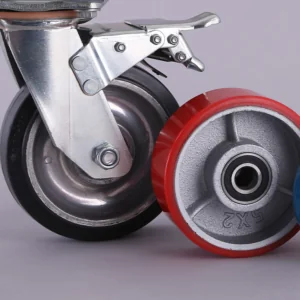
We at Junyi manufacture industrial casters in a range of materials—PU, nylon, rubber, and specialty compounds—with options for different load ratings, wheel diameters, and mounting types. Our heavy-duty welded casters include PU with aluminum or iron cores, cast nylon, and anti-static rubber variants. Each is built for specific factory cart applications.
The correct heavy duty industrial casters make production carts go smoothly, stop securely, and last. Mistakes cause downtime, damage, and frustration. The selecting process begins with numbers, not the catalogue. Our casters at Junyi keep carts moving and operations functioning. Our modular design and uniform specs make replacing casters easy.