Static pallet racking stores product efficiently but handles it passively. Every pallet requires a forklift to access, and selective racking dedicates an aisle to every row. Gravity flow rails change the equation by converting static rack positions into dynamic, gravity-fed lanes.
Pallets load at one end and flow to the pick face automatically. The question is whether you can retrofit existing rack structures instead of investing in an entirely new system. The answer depends on the rack condition, the product profile, and the execution.
Retrofit vs. New Installation: The First Decision
Retrofitting is not always the right choice. New rack installations allow complete design freedom — lane depth, beam spacing, and structural reinforcement can all be specified from scratch. Retrofits work within the constraints of an existing structure.
Retrofitting makes sense when the existing rack is structurally sound and the beam spacing accommodates flow rail installation. It also makes sense when the facility cannot tolerate the downtime or capital expenditure of a full replacement.
Gravity flow rails can be added to existing pallet racking with minimal modification, and flow levels can be retrofitted at specific rack levels while leaving other levels unchanged. If the existing rack has significant structural issues or the product profile requires non-standard lane depths, new installation may be more cost-effective.
Assess the Existing Rack Before Ordering
A successful retrofit begins with a thorough assessment of the existing rack structure. The rack uprights must be plumb and the beams must be level. Any sagging or misalignment will affect flow and create problems.
Measure the beam spacing and the distance between front and rear beams. This determines the maximum flow rail length the structure can accommodate. Verify that the beams have sufficient flange width to support the mounting hardware. Minimum beam sizes vary — some systems require a 3-inch rear beam and a 4-inch front beam, with the front beam 1 inch taller than the rear beam to accommodate the slope.
Check the rack capacity. The addition of flow rails and the dynamic loads from moving pallets add weight to the structure. If the rack is older or has unknown specifications, consult a structural engineer before proceeding.
Component Selection and Slope Calculation
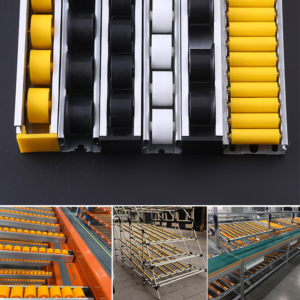
The roller track is the core component. Selection must match the load weight, pallet type, and environmental conditions. For industrial warehousing applications, galvanized sheet metal iron roller tracks offer a reliable solution.
The JY-2046 model at Junyi, for example, features a 40mm width with a 0.8mm wall thickness and a maximum load-bearing capacity of 150kg per meter. The unit weight is 0.935kg per meter. This track uses PP or ESD wheels, ensuring smooth sliding with low resistance.
PP wheels suit standard applications. ESD wheels are required in electronics handling environments where static discharge could damage sensitive components. Pallet type determines track spacing. For standard pallets, two tracks per lane is typical. Non-standard pallets may require wider track spacing or additional guide rails.
Slope is the critical parameter for reliable gravity flow. The general guideline is a 1/2-inch drop per foot of rack depth. For a typical 48-inch-deep rack, this translates to approximately a 2-inch drop from the loading end to the picking end.
The slope must be consistent across the entire lane. It is achieved by mounting the flow rails at different heights on the front and rear beams. Lane width must accommodate the pallet dimensions with adequate clearance — too narrow causes jams, too wide allows drifting.
Installation and Validation
Retrofit installation should minimize disruption to ongoing operations. Prepare components off-site or in a staging area, then install during scheduled downtime.
Mounting hardware attaches the flow rails to the existing rack beams. Pallet flow angles bolt or weld to the flat side of the front and rear structural beams.
The flow rails are fastened to the angles using carriage bolts and whiz lock nuts. The rails must be installed parallel to each other, with the rolling surfaces at 90 degrees to the side channels. Install lane by lane, starting with the lowest rack level and working upward.
After installation, run pallets through each lane at normal operating speed. Pallets should move smoothly without stalling, drifting, or jamming. If pallets stall, the slope may be insufficient or the rollers may be binding.
If pallets move too quickly and impact the stop, the slope may be excessive. The system should maintain consistent pallet spacing without manual intervention. Document the final configuration — rail spacing, slope, and any adjustments — for future reference.
At Junyi, we approach gravity flow rail retrofits with attention to the specific constraints of each existing rack structure. The galvanized sheet metal roller tracks we supply — such as the JY-2046 with its 40mm width, 0.8mm wall thickness, and 150kg per meter load capacity — are designed for integration into standard pallet racking. The PP and ESD wheel options match the application requirements.
The decision to retrofit traditional pallet racking with gravity flow rails adds dynamic storage capability to a fixed asset. The existing rack provides the structure. The flow rails provide the motion.
When the retrofit is planned around the rack’s actual dimensions, the product’s load characteristics, and the operational flow requirements, the result is a storage system that handles today’s throughput and adapts to tomorrow’s product mix.