In the modern logistics landscape, the cost of industrial real estate continues to climb, forcing warehouse managers and supply chain architects to rethink traditional storage methodologies. The challenge is no longer just about having enough inventory; it’s about how much inventory can be squeezed into a fixed footprint without sacrificing throughput. Among the various high-density storage solutions available, gravity-fed systems—specifically those utilizing pallet flow rails—have emerged as a gold standard for companies looking to optimize their spatial economics.
The Geometry of Efficiency: How Pallet Flow Systems Work
Traditional selective racking requires wide aisles to accommodate forklifts between every single row of racks. While this allows for 100% accessibility, it results in a “honeycombing” effect where a significant percentage of the warehouse floor is dedicated to travel paths rather than product storage. Pallet flow systems solve this by utilizing a First-In, First-Out (FIFO) logic through a dynamic storage structure.
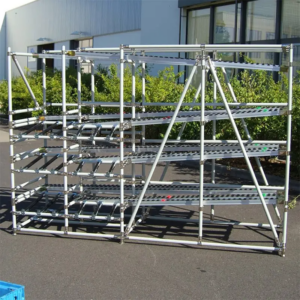
By installing a pallet roller track at a slight pitch (usually 3% to 4%), gravity does the work of moving the product. Pallets are loaded from the “charge” end and glide smoothly toward the “discharge” end. This configuration allows for “deep lane” storage, where 10, 15, or even 20 pallets can be stored in a single lane. By eliminating the need for multiple access aisles, businesses can reclaim up to 60% of their floor space compared to standard racking.
Measuring the Impact on Space Utilization
To truly understand the impact of pallet flow rails on space efficiency, one must look at the “Storage Utilization Rate” (SUR). In a typical selective rack environment, the SUR often hovers around 40% because of the space required for aisles. When transitioning to a flow-based system, the SUR can jump to 75% or 85%.
The efficiency gains are measured through three primary metrics:
- Vertical Cube Utilization: Because flow rails ensure pallets move to the front automatically, there is less need for “dead space” at the top of the rack to allow for forklift maneuvering within the lane.
- Honeycombing Reduction: In standard racks, empty slots often go unused because they are hard to reach. In a flow system, gravity ensures that the next available pallet is always at the pick face, keeping the storage density high at all times.
- Reduced Footprint per SKU: By concentrating high-volume SKUs into deep lanes, the total square footage required to house a specific volume of inventory is drastically reduced, allowing companies to delay expensive warehouse expansions or land acquisitions.
The Technical Role of the Pallet Roller Track
The effectiveness of these systems depends entirely on the friction coefficient and the durability of the track components. A high-quality pallet roller track must be engineered to withstand constant heavy loads—often exceeding 1,000kg per pallet—while maintaining a consistent roll.
Materials play a crucial role here. Heavy-duty steel rollers are typically used for standard pallets, while specialized plastic or coated rollers might be used for specific environmental conditions like cold storage. Furthermore, the integration of speed controllers (centrifugal brakes) within the rail system is essential for safety, ensuring that pallets do not accelerate to dangerous speeds as they travel down the incline.
Engineering Excellence with JunYi: Your B2B Partner
At JunYi, we specialize in the engineering and manufacturing of high-performance flow components designed specifically for the rigorous demands of 2B industrial environments. We understand that for large-scale logistics providers and racking integrators, reliability is not just a preference—it is a requirement for operational continuity.
Our product lineup features high-durability pallet flow rails engineered to facilitate seamless movement within high-density racking systems. We offer comprehensive OEM and ODM services, allowing our partners to customize rail lengths, roller diameters, and load capacities to meet specific project blueprints. Our roller tracks are manufactured using premium-grade galvanized steel and high-impact polymers, ensuring they can withstand the repetitive stress of 24/7 logistics operations.
Why Professionals Choose Our Solutions
As a dedicated manufacturer, we focus on the technical nuances that make a difference in warehouse efficiency. Our pallet roller track options include specialized designs with varying pitch and roller spacing to accommodate different pallet types, including GMA, plastic, or even customized industrial skids.
By choosing JunYi as your supply chain partner, you benefit from:
- Precision Engineering: Our rails are designed for low-noise operation and high load-bearing capacity, ensuring long-term structural integrity.
- Customizable Specifications: Through our ODM services, we provide tailored solutions for unique warehouse layouts, ensuring that every centimeter of your clients’ space is utilized.
- B2B Focused Quality Control: We maintain strict manufacturing standards, providing the consistency required for large-scale industrial rollouts.
The integration of high-quality flow components is the most direct path to increasing warehouse capacity without increasing physical footprints. Whether you are designing a new distribution center or retrofitting an existing facility, our team at JunYi provides the essential hardware to turn gravity into a tool for efficiency. By utilizing our advanced pallet flow rails, businesses can achieve the high-density storage necessary to stay competitive in an increasingly crowded global market. We invite industrial distributors and racking manufacturers to collaborate with us in building the next generation of space-efficient warehouses.