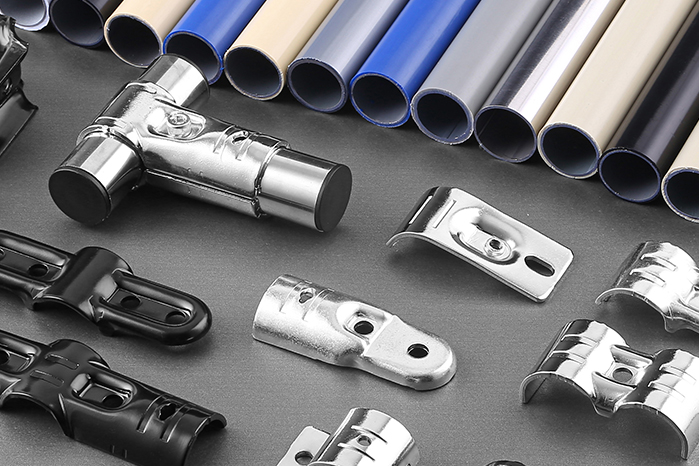
In the high-stakes environment of modern manufacturing, “fixed” is often synonymous with “obsolete.” As production cycles shorten and the demand for customized goods rises, industrial facilities must transition toward modularity. The cornerstone of this transition is the pipe and joint system—a structural framework that allows for the rapid assembly, disassembly, and reconfiguration of essential floor equipment. At the heart of these systems are metal tube connectors, the critical components that determine the structural integrity and flexibility of every workstation, flow rack, and gravity-fed conveyor on the factory floor.
The Engineering Logic of Modular Workstations
A modular workstation is more than just a table; it is a dynamic tool designed to minimize waste (Muda) and maximize ergonomic efficiency. Unlike welded structures, which are permanent and difficult to modify, a system built with metal pipe joints relies on mechanical compression.
The primary advantage of this “Lego-like” industrial assembly is its adaptability. When a production line needs to be rebalanced or a new SKU requires a different assembly layout, a technician only needs a simple hex wrench to loosen the connectors and reposition the structural pipes. This eliminates the need for hot work permits, specialized welding equipment, or lengthy downtime, allowing for “on-the-fly” improvements to the workflow.
Critical Factors in Joint Selection and Assembly
To build a reliable industrial workstation, engineers must consider the mechanical forces at play. The stability of the structure depends on the “clamping force” of the metal tube connectors. A high-quality joint must provide a 360-degree grip on the pipe to prevent slippage under heavy loads.
When designing a workstation, follow these three structural principles:
- Triangulation for Rigidity: While right-angle joints are the standard, incorporating diagonal bracing using multi-angle metal pipe jointssignificantly increases the weight capacity and lateral stability of the frame.
- Ergonomic Adjustability: Modular connectors allow for the fine-tuning of table heights and tool-shelf angles. This customization reduces repetitive strain injuries (RSIs) for operators, which is a key metric in modern B2B safety compliance.
- ESD Integration: In electronics manufacturing, the continuity of the joint system is vital. Selecting connectors with conductive plating ensures that the entire workstation remains grounded, protecting sensitive components from electrostatic discharge.
Technical Specifications of Industrial Metal Joints
The performance of a connector is dictated by its material composition and surface treatment. Standard industrial joints are typically manufactured from cold-rolled steel (SPCC) with a thickness of approximately 2.5mm. This thickness ensures that the joint does not deform under high-torque tightening.
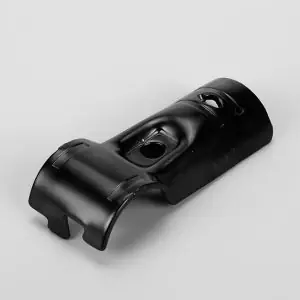
Surface finishes are equally important for durability. Chrome plating provides high wear resistance and a professional aesthetic, while black electrophoresis (ED coating) offers superior corrosion resistance in humid or chemically active environments. For 2B procurement managers, ensuring that the metal tube connectors meet these thickness and coating standards is essential for long-term ROI.
JunYi: Your Global Partner in Modular Component Manufacturing
At JunYi, we specialize in the high-precision manufacturing of structural components for lean production environments. We understand that for our B2B partners—ranging from global automotive manufacturers to specialized factory integrators—the reliability of a single joint can affect the safety of an entire assembly line.
Our extensive range of metal pipe joints is engineered to be fully compatible with standard 28mm diameter coated or stainless steel pipes. We pride ourselves on our role as an OEM/ODM powerhouse, providing the specialized hardware that forms the skeleton of modern industrial workspaces. Because we focus on the 2B sector, our manufacturing processes are optimized for high-volume consistency and technical precision.
Precision and Durability in Every Connection
When you choose JunYi components, you are investing in hardware designed for the rigors of 24/7 industrial use. Our metal tube connectors are characterized by:
- High-Strength SPCC Steel: We utilize premium cold-rolled steel to ensure that every joint maintains its clamping force even after multiple reconfigurations.
- Superior Surface Treatment: Our products undergo rigorous plating or electrophoresis processes, ensuring they remain corrosion-resistant and aesthetically consistent over years of service.
- Standardized Tolerances: We maintain strict quality control to ensure that our joints fit perfectly every time, reducing assembly labor costs for your installation teams.
Expanding Your Capabilities with Our OEM/ODM Services
We recognize that every facility has unique requirements. Through our ODM services, JunYi can develop customized joint configurations to solve specific engineering challenges, such as specialized load-bearing brackets or unique angular connectors. Our goal is to empower our clients to build smarter, faster, and more resilient workstations.
By integrating our metal pipe joints into your facility designs, you ensure a professional-grade finish that meets international lean manufacturing standards. We provide the structural reliability you need to support your workers and your bottom line. As a dedicated B2B manufacturer, we are committed to providing the scalability and technical support required to facilitate large-scale industrial rollouts across the globe.