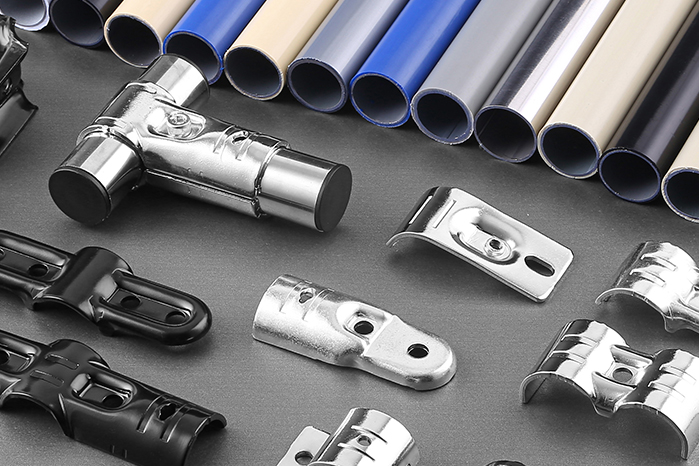
In the landscape of modern industrial engineering, the ability to adapt is more valuable than the ability to remain rigid. The rise of “Lean” manufacturing has transformed the factory floor from a collection of heavy, welded structures into a dynamic environment of modular workstations, gravity flow racks, and custom material handling carts. The “glue” that holds this modular world together is the lean pipe joint. While these components may seem simple, choosing the right lean pipe connectors requires a deep understanding of mechanical force, material science, and the specific ergonomic needs of a production line.
The Physics of the Joint: Friction vs. Fastening
At its core, a lean pipe joint is a mechanical clamping system. Unlike traditional threaded pipes or welded joints, lean systems rely on high-tension friction to secure 28mm pipes into a rigid structure. The science behind a high-quality connector involves two primary factors: surface contact area and clamping torque.
A well-engineered connector is designed to wrap around the circumference of the pipe, maximizing the surface-to-surface contact. This distribution of pressure ensures that the joint can support significant vertical loads without slipping. When choosing connectors, engineers must consider the “pull-out strength”—the amount of force required to move the pipe once the joint is tightened. For 2B industrial applications, where safety and structural integrity are paramount, a connector that utilizes high-tensile bolts and nuts is essential to maintain this clamping force over thousands of hours of vibration and use.
Identifying the Right Connector for the Task
The versatility of the lean system comes from the variety of joint configurations available. Selecting the right one depends on the geometry of the structure you are building:
- 90-Degree Structural Joints: These are the foundations of any frame. They provide the “T” and “L” intersections for workstations and shelving units.
- Rotational and Multi-Angle Joints: For ergonomic assembly lines, workstations often require tilted shelves or adjustable tool mounts. Multi-angle lean pipe connectorsallow for a 180-degree range of motion, enabling designers to tailor the station to the operator’s specific reach.
- Structural Strengthening Joints: In high-load scenarios, such as heavy-duty flow racks, “cross” or “star” joints are utilized to provide multi-directional bracing, preventing the frame from swaying under the weight of inventory.
Material and Coating Selection for Industrial Longevity
In a professional 2B environment, the material of the connector is just as important as its shape. Most industrial joints are manufactured from cold-rolled steel (SPCC) with a thickness of approximately 2.5mm. However, the surface treatment is what determines its lifespan:
- Black Electrophoresis (ED): This provides a smooth, uniform finish with excellent corrosion resistance. It is the industry standard for general manufacturing.
- Chrome Plating: Offers a high-hardness surface that is resistant to scratching and wear, ideal for “Clean Room” or high-aesthetic environments.
- Zinc Plating: A cost-effective solution for standard warehousing, providing a sacrificial layer to prevent rust in humid conditions.
JunYi: Precision Engineering for Modular Excellence
At JunYi (Shenzhen Junyi Storage Equipment Co., Ltd.), we specialize in the manufacturing of the high-strength components that form the skeleton of the global supply chain. We understand that in the 2B sector, a single component failure can lead to operational downtime. That is why our lean pipe joint series is engineered to exceed the rigorous demands of automotive, electronics, and logistics industries.
Our flagship connector, the JYJ-1, is the embodiment of our commitment to structural reliability. As a dedicated OEM and ODM manufacturer, we have refined the design of our connectors to ensure they provide the highest possible clamping force with the easiest assembly process.
Technical Specifications of the JunYi JYJ-1 Joint
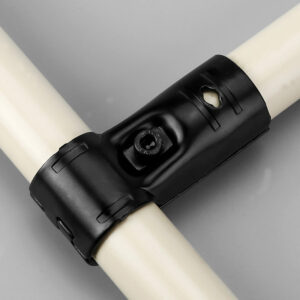
The JYJ-1 is a standard 90-degree metal joint set, often used to connect two pipes in a “T” or “L” configuration. Based on our technical data, the JYJ-1 offers:
- Material: SPCC(Cold-hardened steel plate)
- Metal joint thickness: T:2.5mm, error < 0.05
- Product unit weight (including screw nuts) : 0.147kg/set
- Packaging quantity: 100 sets/carton
- Carton packaging specification: 260*210*120 (mm)
- Packaging requirements: Carton +PVC plastic bag COLOR:BK、WZ、VI、PI
Why B2B Partners Choose JunYi Connectors
When you integrate JunYi lean pipe connectors into your facility, you are choosing a partner that values precision and scalability. Our manufacturing process utilizes automated stamping and rigorous quality control to ensure that every lean pipe joint we ship has the exact same dimensions and metallurgical properties. This consistency is vital for large-scale facility rollouts where thousands of joints must perform identically.
Through our ODM and OEM services, we can also provide:
- Customized Thickness: For ultra-heavy-duty applications, we can adjust the gauge of the steel used in our connectors.
- Branded Solutions: We offer the ability to stamp your proprietary logos or part numbers directly into the metal, supporting your brand identity in the global market.
- Anti-Static (ESD) Integration: We provide specialized conductive coatings for our joints to ensure that your workstations maintain a continuous path to ground in sensitive electronics assembly areas.
In the world of 2B industrial supply, the strength of your facility is only as good as the joints that hold it together. By choosing JunYi mobility and structural solutions, you are investing in a system that is built to last, easy to modify, and designed for peak efficiency. We invite industrial designers and procurement managers to explore our full range of connectors and see how our engineering can support your next Lean initiative.