In the architecture of a lean manufacturing facility, mobility is the literal vehicle of productivity. While often overlooked as a simple mechanical commodity, the selection of rubber wheels is a critical engineering decision that affects everything from floor preservation to sensitive component safety. As global supply chains shift toward high-frequency, small-batch logistics, the physical interface between the transport rack and the factory floor—the caster—must be selected with technical precision.
Choosing the wrong mobility solution can lead to “vibration waste,” premature floor degradation, and increased physical strain on operators. To ensure operational continuity, industrial procurement managers and facility engineers must evaluate five core scientific and mechanical factors when sourcing rubber wheel casters.
- Durometer and Shore Hardness
The hardness of a wheel, measured on the Shore A scale, dictates its interaction with the floor. Rubber wheels typically fall within a range that balances “cushion” with “rollability.” A softer rubber provides superior shock absorption, which is essential for transporting fragile electronic sub-assemblies or glass components. However, a rubber that is too soft will have a high “starting resistance,” requiring more force from the operator to begin movement. The ideal industrial caster provides enough deflection to absorb floor debris while maintaining a round profile under load.
- Load Distribution and Dynamic Capacity
There is a significant difference between “static load” (the weight a wheel holds while stationary) and “dynamic load” (the weight it carries while in motion). For B2B logistics, the dynamic capacity is the more critical metric. When a cart turns or hits a floor joint, the weight distribution shifts momentarily to only one or two wheels. Engineering a safety factor of 33% is standard; for a four-wheeled cart, the total load should be divisible by three to ensure the rubber wheel casters do not undergo catastrophic deformation during high-speed transit.
- Rolling Resistance and Energy Efficiency
In large-scale warehouses, “Muda” (waste) often manifests as unnecessary physical exertion. Rolling resistance is the energy lost as a wheel deforms and recovers while rolling. High-quality synthetic rubber compounds are engineered to have high “rebound” characteristics. This means the wheel returns to its original shape quickly after being compressed, translating more of the operator’s push-force into forward momentum. This reduces cumulative fatigue and increases the speed of “Milk Run” logistics cycles.
- Environmental Compatibility and Floor Protection
Unlike steel or hard nylon wheels, rubber is non-marking and non-destructive. However, environmental factors such as oil exposure, chemical cleaners, or extreme temperatures can cause “chunking” or hydrolysis in standard rubber. For 2B environments, it is essential to specify whether the wheels will encounter “shop floor fluids.” Specialized rubber blends are required to ensure the tread does not swell or become brittle when exposed to industrial lubricants.
- Electrostatic Discharge (ESD) Safety
In semiconductor and automotive electronics manufacturing, the wheel is the primary grounding path. As a cart moves, friction generates static electricity. Without a conductive path, this charge accumulates and can discharge into sensitive components. The integration of anti-static properties within the rubber matrix is no longer an optional feature—it is a baseline requirement for modern industrial mobility.
JunYi: Your Partner in High-Precision Mobility Solutions
At JunYi, we specialize in the manufacturing of modular industrial components that meet the rigorous standards of global 2B enterprises. We understand that our partners—integrators, OEM manufacturers, and logistics planners—do not just buy parts; they buy reliability. Our mobility division is dedicated to engineering rubber wheels that address the five critical factors mentioned above, ensuring your facility operates at peak efficiency.
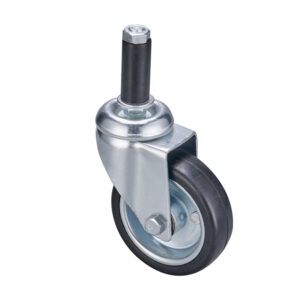
Our JunYi Medium-Sized Black Anti-Static Rubber Caster is a testament to our commitment to technical excellence. While many manufacturers focus on the consumer market, our products are built specifically for the high-intensity cycles of the industrial floor.
Technical Specifications of our 4-Inch and 5-Inch Series
To assist in your procurement planning, we provide precise specifications sourced directly from our engineering data:
- Tread Material: High-grade synthetic rubber with specialized anti-static additives.
- Surface Resistivity: 10^3 to 10^6 Ω, ensuring a safe and consistent path to ground for ESD-sensitive environments.
- Bearing Construction: Double ball-bearing raceways with dust-sealed covers to prevent the ingress of industrial debris.
- Mounting Options: Available in expanding stem configurations for pipe systems or heavy-duty top plates for flat-surface mounting.
Why B2B Leaders Choose JunYi
As an OEM and ODM provider, we offer a level of customization that standard retailers cannot match. Whether your project requires a specific wheel diameter for ground clearance or a customized brake mechanism for steep-gradient safety, our team is equipped to deliver.
By choosing JunYi rubber wheel casters, you are investing in “Lean” components that reduce noise, protect your facility’s flooring, and ensure the safety of your operators. We pride ourselves on the durability of our materials; our rubber compounds are tested for high abrasion resistance, ensuring a lower “Total Cost of Ownership” (TCO) compared to generic alternatives.
In the world of 2B industrial supply, the small details—like the rebound of a rubber tread or the conductivity of a caster—make the difference between a smooth operation and a costly bottleneck. We invite you to explore how our specialized mobility solutions can be integrated into your next modular racking or workstation project.