In the visual landscape of a global distribution center or an automotive assembly plant, there is a recurring aesthetic: the presence of black-treaded wheels on almost every mobile rack, trolley, and workstation. While the choice of color might seem arbitrary to the casual observer, in the 2B industrial sector, “black” is a functional specification rather than a stylistic preference. The dominance of black casters in heavy-duty logistics is the result of decades of material science, specifically regarding carbon reinforcement, durability under load, and the critical management of electrostatic discharge.
The Role of Carbon Black in Material Durability
The primary reason most high-performance rubber wheels are black is the addition of “carbon black” during the vulcanization process. Carbon black is a paracrystalline material that acts as a reinforcing filler. When integrated into the rubber matrix, it fundamentally alters the mechanical properties of the wheel.
From a popular science perspective, carbon black works by increasing the surface area for polymer chain interaction. This translates into several key industrial advantages:
- Abrasion Resistance: Logistic carts in 24/7 environments travel miles of concrete every day. Carbon-reinforced rubber resists “scrubbing” and wear significantly better than non-reinforced polymers.
- Thermal Conductivity: Friction generates heat. Carbon black helps dissipate thermal energy from the tread to the hub, preventing the rubber from softening or deforming during high-speed “Milk Run” operations.
- UV Protection: In facilities with high exposure to sunlight or industrial UV lighting, carbon black acts as a stabilizer, preventing the polymer chains from breaking down (photo-oxidation) and turning brittle.
Managing the Invisible Threat: Static Electricity
One of the most compelling reasons for the standardization of black casters is the requirement for conductivity. In a logistics environment, the constant friction between a wheel and the floor generates a significant amount of static electricity through the triboelectric effect. If the wheel is an insulator (like many clear or colored plastics), this charge builds up on the metal frame of the cart.
In sectors such as electronics assembly, aerospace, and medical device logistics, a sudden static discharge (ESD) can destroy sensitive microprocessors or trigger fires in volatile environments. Carbon black is inherently conductive. By precisely controlling the volume of carbon in the rubber compound, manufacturers can create a wheel that acts as a continuous bridge to the ground, safely bleeding off static electricity before it can accumulate.
Maintenance and Professional Aesthetics
In the 2B world, the “total cost of ownership” includes the labor required for facility maintenance. Non-marking grey or white wheels are often used in hospitals to show cleanliness, but in a heavy industrial setting, they quickly become stained with grease, metal shavings, and floor dust. Black casters maintain a professional appearance over a longer service life by masking superficial stains, allowing maintenance teams to focus on mechanical integrity rather than cosmetic cleaning.
JunYi: Engineering the Next Generation of Industrial Mobility
At JunYi, we specialize in providing the high-strength components that power modular lean manufacturing. We understand that for our partners—ranging from racking system integrators to international logistics providers—the caster is a critical point of failure that must be engineered for maximum reliability.
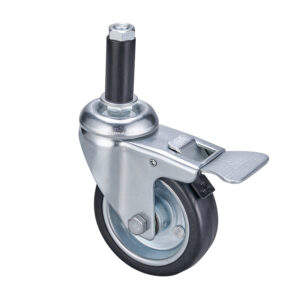
Our JunYi Medium-Sized Black Anti-Static Rubber Caster is the result of rigorous testing in high-demand environments. We have optimized our carbon-infused rubber formula to ensure that our wheels provide the perfect balance between floor protection and industrial-grade durability.
Technical Specifications of the JunYi Black Series
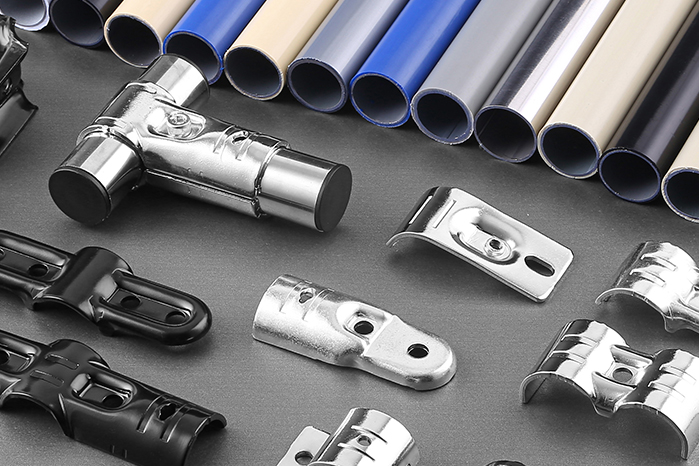
For procurement managers and engineers, we provide precise specifications to ensure our components meet your structural requirements. Our black anti-static series is designed to integrate seamlessly into standard pipe and joint systems:
The JunYi Advantage: OEM and ODM Excellence
As a dedicated B2B manufacturer, we go beyond off-the-shelf solutions. We recognize that different floor surfaces and load profiles require specific rubber densities. Through our ODM services, we can adjust the durometer (hardness) of our rubber wheels to suit your specific facility conditions—whether you are operating on polished epoxy, rough concrete, or checkered plating.
By choosing JunYi as your supply partner, you benefit from:
- Consistent Conductivity: We verify the anti-static properties of every batch to ensure they meet international safety standards for electronics manufacturing.
- Structural Integrity: Our yokes and mounting stems are manufactured from high-grade galvanized steel, ensuring the black casters can withstand the lateral forces of fully loaded carts.
- Lean Compatibility: Our casters are specifically designed for “Lean” environments, facilitating the quick assembly of modular workstations and flow racks.
In the complex world of industrial logistics, the color black represents more than just a tradition; it represents a commitment to material performance and operational safety. At JunYi, we take pride in manufacturing the “silent partners” of your production floor. Our mobility solutions are built to ensure that your logistics carts move with precision, safety, and a low total cost of ownership.