Your facility moves sensitive equipment—analytical instruments, computer servers, medical devices, testing equipment. Each move is an opportunity for static discharge to occur. Whether that discharge causes damage, corrupts data, or merely generates an annoying spark depends on what you’re moving and how deliberately you’ve prepared for the risk.
Static discharge occurs in virtually every environment; what matters is whether it poses a measurable risk to the equipment in question, and whether anti-static casters pay back their added cost in that application. For equipment manufacturers and facilities, we at Junyi provide anti-static caster options designed to address different levels of static-discharge risk.
What Equipment Is Actually at Risk from Static Discharge
Static sensitivity varies dramatically across equipment types. Understanding your vulnerability guides whether anti-static protection is necessary or precautionary.
Equipment most vulnerable to static damage includes: semiconductor testing equipment, computer servers and network infrastructure, laboratory instrumentation (spectrophotometers, gas chromatographs, analytical balances), medical diagnostic devices (ultrasound machines, patient monitors), and manufacturing control systems. These devices contain integrated circuits that can be damaged by electrostatic discharge (ESD) events. The damage may be immediate (component failure, data corruption) or latent (weakened component that fails months later).
Many facilities operate a mix: sensitive equipment requiring protection, and non-sensitive equipment that doesn’t require it. A data center with servers and uninterruptible power supplies (UPS) requires anti-static casters. A warehouse moving pallets of raw materials doesn’t.
Documentation reveals your equipment’s sensitivity. Check the technical specifications or operating manuals for ESD sensitivity ratings, handling requirements, or grounding specifications. Manufacturers of sensitive equipment often provide specific guidance on safe handling, including whether grounded caster systems are necessary.
How Static Charge Accumulates During Equipment Movement
Static electricity isn’t mysterious—it’s the result of charge imbalance. Understanding how charge accumulates reveals why and when protection matters.
As equipment wheels roll across a floor, friction between the wheel surface and floor generates charge separation. Electrons transfer from one surface to the other, leaving one surface positively charged and the other negatively charged. If the equipment and floor remain electrically isolated, charge accumulates continuously. The charge seeks a path to dissipate, and that path is often through sensitive electronics.
The rate of charge accumulation depends on several factors: wheel material (different materials generate different charge densities), floor type (carpet generates more charge than concrete), humidity (low humidity increases charge retention), and wheel speed (faster movement generates more friction). In a cool, dry environment with carpeted floors, isolated equipment can accumulate dangerous charge levels within seconds of movement.
This mechanism is why anti-static casters matter: they provide a conductive path that allows charge to dissipate continuously rather than accumulating to dangerous levels.
Assessing Your Environment: Is Static Risk Real or Theoretical
Static risk depends on your specific conditions, not worst-case assumptions. Dry environments (below 40% relative humidity) increase charge buildup, while humidity above 60% naturally reduces static accumulation. Floor type also matters, with carpet generally generating more static than hard floors.
Equipment isolation is another key factor. Sensitive equipment connected to grounded, conductive workbenches or tables can dissipate static charge, while non-conductive stands or surfaces allow charge to accumulate. The frequency of movement also affects exposure: equipment moved daily faces greater risk than equipment moved rarely.
Static risk is highest when sensitive equipment is moved frequently in dry conditions, across insulating floors, or while isolated from grounding. In these situations, anti-static casters provide meaningful protection; in humid, controlled environments with infrequent movement, the need may be lower.
The Difference Between Static-Dissipative and Conductive Casters
Conductive casters typically have resistance below 1 megohm, providing a direct path for continuous charge dissipation when both the equipment and floor are grounded. They are best suited for controlled ESD-sensitive environments with established grounding systems.
Static-dissipative casters typically have resistance of 1–100 megohms, limiting current flow while allowing charge to dissipate gradually. They are more practical for general facilities without dedicated ESD infrastructure, where continuous grounding may not be guaranteed.
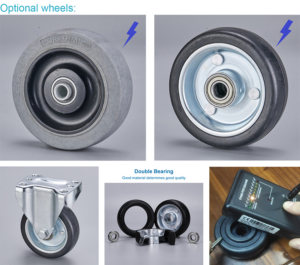
We at Junyi offer casters with conductive wheel options, along with various wheel materials such as rubber, TPR, PU, and PVC for different applications. Specifying the correct type for your environment and equipment ensures protection actually functions as intended.
Specifying Anti-Static Casters Correctly to Maintain Protection
Installing anti-static casters doesn’t guarantee protection if installation and maintenance don’t preserve the protection.
Grounding connection must be established if using conductive casters. A caster that provides low-resistance electrical path is ineffective if that path doesn’t connect to ground. For conductive casters on grounded equipment or workbenches, ensure the equipment frame is properly grounded and contact between caster and frame remains clean and corrosion-free.
Floor compatibility matters. Anti-static casters designed for conductive floors perform differently on insulating floors. If your facility has non-conductive flooring (vinyl, rubber, or unsealed concrete), conductive casters may not function as intended. Static-dissipative casters are typically more appropriate for non-conductive floors.
Wheel material degradation affects performance. Casters with conductive or static-dissipative compounds degrade over time as the material wears. The electrical properties that provided protection may decrease as the wheel surface degrades. Worn rubber wheels with anti-static properties may no longer provide adequate protection.
Moisture and contamination on wheels reduce electrical performance. Dirt, debris, or dried salt residue can insulate the wheel from the floor, preventing charge dissipation. Clean anti-static casters regularly—simply wiping wheels with a damp cloth restores electrical contact.
Load rating compatibility is essential. Anti-static casters must support the equipment weight. Undersized casters strain the wheel material, accelerating degradation and potentially failing catastrophically. Specify casters rated for equipment weight plus a safety margin.
When Standard Rubber Wheels Are Sufficient
Not every application requires anti-static casters. Acknowledging this prevents over-specification and wasted investment.
Equipment without electronic components or with robust electronic systems designed for harsh environments typically tolerates standard casters. Industrial equipment with heavy-duty motor controllers, equipment housed in grounded metal enclosures, and non-electronic furniture don’t require anti-static protection.
Applications in naturally humid environments (coastal facilities, food processing areas with spray systems, agricultural operations) generate less static charge, making anti-static casters less critical even for sensitive equipment. The environment itself provides partial protection.
Cost-conscious procurement may consider standard wheels to reduce costs. The right choice depends on equipment sensitivity and the operating environment. For static-sensitive equipment, anti-static casters can help prevent costly damage, while standard wheels may be sufficient for less sensitive applications.
Matching Protection to Actual Risk
Anti-static casters protect sensitive equipment by preventing charge accumulation during movement. Whether that protection justifies the cost depends on three factors: equipment vulnerability to static damage, your facility’s environmental conditions, and how frequently equipment moves.