Medical Equipment Casters with Brakes
In the sterile, high-stakes environment of a healthcare facility, mobility is a double-edged sword. While the ability to rapidly transport diagnostic machines, surgical carts, and patient monitors is essential for life-saving interventions, the ability to transition that equipment into a state of absolute stability is equally vital. Unlike industrial warehouses where floor surfaces are relatively consistent, medical environments demand a level of precision that standard mobility solutions cannot provide. This is why specialized medical equipment casters with integrated braking systems are a non-negotiable requirement for healthcare infrastructure.
The Physics of Stability in Clinical Settings
From a popular science perspective, the necessity of brakes on medical casters is rooted in the management of kinetic energy and center-of-gravity dynamics. Many medical devices, such as ultrasound machines or portable X-ray units, are top-heavy. Without a high-friction locking mechanism, even a slight incline in a hospital floor or a minor bump from a passing staff member could cause the equipment to drift.
A “drift” in a clinical setting is not merely an inconvenience; it can be catastrophic. During a delicate procedure, a monitor that shifts by even a few centimeters can disrupt a surgeon’s line of sight or pull on sensitive sensor cables. The braking system on medical equipment casters serves to convert a mobile unit into a stationary workstation instantaneously, ensuring that the “stationary” state is maintained despite external vibrations or accidental contact.
Why Rubber Wheels are the Gold Standard for Hospitals
The material choice for the tread is the first line of defense in medical safety. Rubber wheels are preferred in clinical settings for several technical reasons:
- Vibration Dampening: Hospital floors are often made of hard vinyl or tile. High-elasticity rubber absorbs the micro-vibrations caused by rolling, protecting the sensitive internal calibration of laser equipment and optical sensors.
- Acoustic Control: Silence is a component of patient recovery. Rubber treads eliminate the “chatter” of metal or hard plastic wheels, allowing for the stealthy movement of equipment during night shifts.
- Grip and Traction: When a brake is engaged, the effectiveness of the lock is limited by the friction between the wheel and the floor. Rubber provides a high coefficient of friction, ensuring that the wheel “bites” into the floor surface rather than sliding across it.
Types of Braking Systems in Medical Environments
Not all brakes are created equal. In the medical sector, we typically see three specialized locking configurations:
- Side Brakes: A simple lever on the side of the wheel that prevents rotation.
- Total Lock Brakes: A more advanced system that locks both the wheel’s rotation and the swivel housing. This is essential for equipment that must remain perfectly oriented in a specific direction.
- Directional Locks: These lock the swivel but allow the wheel to rotate, making it easier to steer long trolleys through narrow corridors before locking them into a straight-line path.
JunYi: Engineering Reliability for the Healthcare Sector
At JunYi, we specialize in the manufacturing of high-performance mobility components that bridge the gap between industrial durability and medical precision. While our roots are in the 2B industrial and logistics sectors, our engineering standards for medical equipment casters are designed to meet the rigorous safety protocols required by modern healthcare facilities.
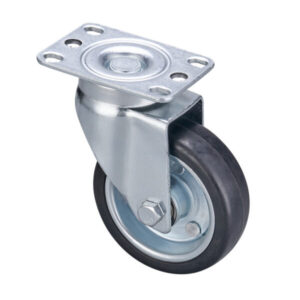
We understand that for our B2B partners—medical device OEMs and hospital furniture manufacturers—the caster is a critical safety component. Our JunYi Medium-Sized Black Anti-Static Rubber Caster is engineered to provide the silent, stable, and static-free mobility that clinical environments demand.
Technical Specifications of JunYi Medical-Grade Solutions
Our casters are built to ensure that “Work in Progress” remains safe, whether that work is an industrial assembly or a patient diagnostic procedure. For medical-adjacent applications, our components offer:
- Anti-Static Performance: Hospitals are filled with oxygen and sensitive electronics. Our rubber wheels feature a surface resistivity of 10^3Ω to 10^6Ω, preventing the accumulation of static electricity that could interfere with patient monitoring equipment.
- High-Load Integrity: Our medium-sized series is rated for significant weight capacities, utilizing reinforced steel yokes that do not flex under the weight of heavy diagnostic modules.
- Precision Braking: Our integrated braking mechanisms are designed for thousands of cycles of engagement without failure. The “Total Lock” capability ensures that both the wheel and the swivel are secured with a single foot-press, providing immediate stability.
- Non-Marking Materials: Despite the industrial-strength black finish, our specialized rubber compounds are designed to be non-marking, preserving the integrity of expensive hospital flooring.
Customization through OEM/ODM Services
As a dedicated manufacturer, JunYi offers extensive ODM (Original Design Manufacturing) capabilities. We recognize that medical equipment often requires specific mounting heights or specialized stem diameters to fit into proprietary modular frames. We can customize the stem length, the brake lever ergonomics, and the wheel durometer to ensure the caster is perfectly tuned to the weight and center of gravity of your specific medical device.
Choosing JunYi means choosing a partner who understands the high stakes of 2B medical supply chains. We don’t just provide parts; we provide the foundation for stable, reliable, and safe healthcare delivery. Our commitment to using high-grade materials and precision manufacturing ensures that when a nurse or technician engages a JunYi brake, the equipment stays exactly where it is needed.