Navigating Healthcare Logistics: Selecting the Right Medical Equipment Casters for Hospital Trolleys
In the complex ecosystem of a modern hospital, the “silent movers”—the trolleys and carts—form the backbone of daily operations. From mobile workstations and medication carts to surgical instrument trolleys and diagnostic equipment stands, the efficiency of healthcare delivery is inextricably linked to the mobility of these units. Selecting the appropriate medical equipment casters is not merely a procurement checkbox; it is a critical decision that impacts patient safety, staff ergonomics, and the longevity of high-value medical technology. Unlike industrial settings, the hospital environment introduces a unique set of variables: the need for absolute sterility, acoustic control, and specialized protection against electrostatic interference.
The Physics of Clinical Mobility: Why Material Science Matters
When a hospital trolley moves through a facility, it encounters various floor types—from polished epoxy in operating theaters to textured vinyl in patient wards and even thresholds at elevator entrances. The interaction between the wheel and these surfaces is a study in friction and dampening.
For healthcare applications, rubber wheels are the primary choice of engineers for their superior elastic deformation properties. When a trolley loaded with sensitive diagnostic equipment encounters a floor joint, a hard wheel (such as nylon or steel) transmits a high-frequency shock throughout the frame. This vibration can misalign delicate sensors or loosen precision fasteners. High-grade rubber, however, acts as a passive suspension system, absorbing the kinetic energy and ensuring a “smooth-bore” transit. This dampening effect is essential for maintaining the calibration of mobile X-ray units, ventilators, and infusion pumps.
Acoustic Ergonomics and the Recovery Environment
A secondary but vital scientific consideration in hospital trolley design is acoustics. Decibel levels in hospitals are closely monitored, as excessive noise is proven to increase patient cortisol levels and contribute to “alarm fatigue” among nursing staff.
Standard industrial casters often produce a rhythmic “clatter” or “squeak” caused by metal-on-metal friction in the swivel or the hard impact of wheels on tile. Specialized medical equipment casters utilize precision ball bearings that are permanently lubricated and sealed. When paired with high-rebound rubber treads, these components allow trolleys to glide silently, even during the night shifts when patient rest is paramount.
The ESD Variable: Protecting Sensitive Diagnostics
Perhaps the most critical technical factor in selecting casters for hospital trolleys is the management of Electrostatic Discharge (ESD). As rubber wheels roll, they can generate static electricity through friction. In an environment rich with oxygen and populated by micro-processed electronic devices, an uncontrolled static spark can lead to catastrophic failure.
Advanced medical casters are engineered with conductive or dissipative properties. By integrating carbon-based elements into the rubber matrix, the wheel becomes a grounding path. This ensures that any static charge generated by the trolley’s movement is continuously bled off into the conductive flooring, protecting both the operator and the sensitive medical hardware from the invisible threat of a static surge.
Engineering Precision with JunYi: B2B Solutions for Medical Logistics
At JunYi, we specialize in the high-volume production of industrial-grade components designed for the rigorous demands of the global 2B market. While our roots lie in lean manufacturing and industrial storage, our commitment to precision engineering makes us a trusted partner for manufacturers of medical-adjacent equipment and hospital logistics systems.
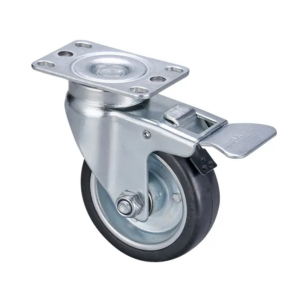
Our JunYi Medium-Sized Black Anti-Static Rubber Caster is a prime example of a crossover technology that meets the stringent requirements of the healthcare sector. We understand that for our B2B partners—ranging from medical cart OEMs to facility management firms—the reliability of a caster is directly linked to the professional reputation of the final product.
Technical Specifications of the JunYi Medical-Grade Series
Our casters are built to provide the structural rigidity of an industrial component with the refinement required for a clinical setting. Based on our engineering data, our medium-sized series offers the following precise specifications:
- Tread Composition: High-density, non-marking synthetic rubber optimized for vibration dampening and low rolling resistance.
- Anti-Static Integrity: Every unit in this series is engineered to provide a surface resistivity of 10^3Ω to 10^6Ω, meeting the global standards for ESD safety in sensitive electronic environments.
- Load-Bearing Performance: Our yokes are manufactured from cold-rolled steel with a reinforced swivel head, ensuring that trolleys can carry heavy diagnostic modules without “swivel-lock” or deformation.
- Braking Precision: We offer “Total-Lock” braking options, which secure both the rotation of the rubber wheelsand the swivel direction simultaneously, providing an instant stationary workstation for medical staff.
Supporting Your OEM and ODM Requirements
As a dedicated manufacturer, JunYi provides more than just off-the-shelf parts. We offer comprehensive ODM (Original Design Manufacturing) services to adapt our mobility solutions to your specific trolley designs. Whether your project requires specialized expanding stems for 28mm modular pipes or custom plate-mount dimensions for heavy-duty patient monitors, our engineering team is equipped to deliver.
We recognize that the healthcare sector demands consistency. Therefore, we maintain strict quality control protocols to ensure that every batch of medical equipment casters we ship meets the exact tolerances required for professional medical furniture. By choosing JunYi, you are opting for a partner that values technical transparency and industrial durability.
In the fast-paced world of hospital logistics, the difference between a functional trolley and a superior one often lies in the quality of the wheels beneath it. We invite medical equipment designers and procurement managers to explore how our specialized rubber wheels can enhance the safety, silence, and stability of their next generation of hospital trolleys.