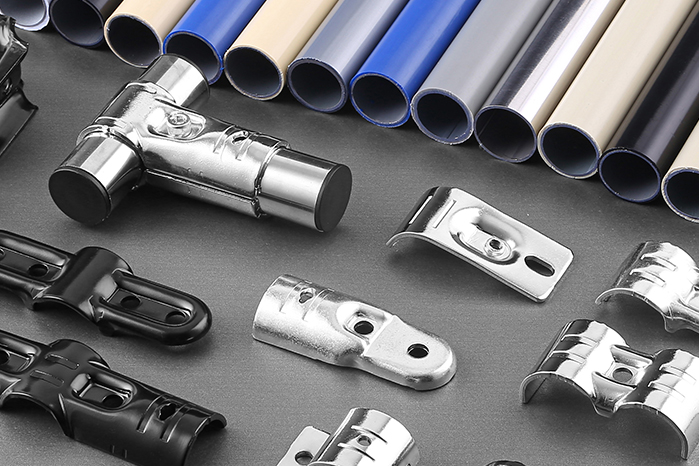
A tube and joint system is only as strong as its connections. The pipes provide the span, but the joints carry the loads, transmit the forces, and maintain the alignment. A failed joint, whether caused by loosening, corrosion, or deformation, can compromise the stability and reliability of the overall structure.
Structural integrity depends on the joint’s ability to resist these failure modes. At Junyi, our high-strength metal pipe joints are designed to provide reliable load-bearing performance in tube and joint systems. But high strength is not a single attribute. It is the result of material, geometry, fastening method, and surface treatment working together.
What High-Strength Means in a Pipe Connector Joint
High-strength in a metal pipe connector joint does not simply mean “thick metal.” A thick joint made from poor material will deform under load. A thin joint made from high-grade material may carry more than a thicker but weaker alternative.
High strength means the joint can resist deformation, maintain clamping force, and preserve its connection geometry under the loads it is rated for — without permanent set or loosening over time.
This capacity depends on multiple variables: the grade and thickness of the material, the distribution of stress across the joint geometry, the effectiveness of the fastening method in maintaining clamp force, and the durability of the surface treatment in preventing corrosion that would degrade strength. Each of these factors contributes to the joint’s ability to preserve structural integrity under real operating conditions.
Material Grade and Thickness: The Baseline of Strength
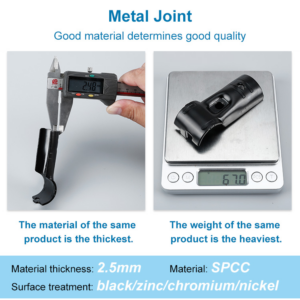
The foundation of any high-strength joint is the material from which it is manufactured. The joint must have sufficient yield strength to resist permanent deformation under load and sufficient tensile strength to withstand the forces transmitted through the connection.
Material grade determines these properties. A joint made from cold-rolled steel, for example, offers a different strength profile than a joint made from lower-grade materials.
Thickness, or the metal’s gauge, works together with the material grade to determine the tube’s overall performance. Thicker material provides greater cross-sectional area to resist bending and spreading forces. But thickness alone does not guarantee strength. A joint that is thick but poorly formed or made from low-grade material will still fail.
The combination of appropriate material grade and sufficient thickness is what establishes the baseline load capacity. This is why specifying a high-strength joint requires attention to both the material specification and the thickness dimension.
Connection Geometry Determines How Load Is Distributed
Material provides the capacity. Geometry determines how that capacity is utilized. A high-strength metal pipe connector joint features geometry that distributes load across multiple surfaces rather than concentrating stress at a single point. The dovetail snap, for instance, creates multiple contact surfaces between the joint and the pipe, spreading the load and reducing the risk of localized deformation.
The connection between a metal joint and a lean pipe relies on mechanical engagement. The head features a dovetail-shaped snap that connects to the lean pipe through both the snap and the screw.
This dovetail design creates a positive mechanical lock between the joint and the pipe surface. The geometric lock resists movement in multiple directions, preventing the pipe from pulling out or rotating under load. This is not a secondary feature — it is a primary mechanism that enables the joint to carry significant loads without slipping.
A joint with poorly designed geometry concentrates stress at sharp corners or narrow contact points, creating failure initiation sites. A high-strength joint avoids these stress risers through radiused edges, broad contact surfaces, and a shape that encourages even load distribution. Geometry is not about appearance — it is about force management.
The Fastening Method Must Match the Load Profile
The snap provides the geometry. The screw provides the force. A high-strength metal pipe connector joint connects to the lean pipe through the snap and the screw. The screw applies clamping pressure that compresses the joint against the pipe surface, creating friction that resists movement. This friction, combined with the dovetail snap’s geometric lock, enables the joint to carry loads without slipping.
The fastening method must be capable of maintaining clamp force under the specific load profile of the application. Static loads — where the structure remains stationary — place different demands on the screw than dynamic loads — where the structure vibrates, moves, or experiences impact. A high-strength joint is designed to resist loosening from vibration and thermal cycling through thread design, screw material, and appropriate engagement depth.
When the screw maintains its clamping force, the joint maintains its structural integrity. When the screw loosens, the joint loses capacity regardless of the material or geometry. Fastening method quality is therefore not a secondary detail — it is a primary determinant of joint reliability and a key factor in high-strength performance.
Surface Treatment Preserves Strength Over Time
Strength at the time of installation is only half the equation. A joint that corrodes loses material cross-section, pitting surfaces and degrading threads. What was initially a high-strength joint becomes progressively weaker. This is why surface treatment matters not just for appearance but for long-term structural performance.
A metal pipe connector joint with an electroplated coating on the surface offers a long service life by protecting the underlying metal from corrosion. Electroplating provides a barrier against moisture, chemicals, and atmospheric corrosion that would otherwise attack the joint material.
The durability of the coating determines how long that protection lasts. A properly applied electroplated coating maintains its integrity over years of service, preserving the joint’s dimensional accuracy and load-bearing capacity.
Surface treatment is not separate from strength — it is the factor that keeps the strength intact over time. For tube and joint systems in humid environments, washdown areas, or outdoor applications, this corrosion protection is essential for ensuring that the joint remains high-strength throughout its service life.
Rated Load Capacity and Application Fit
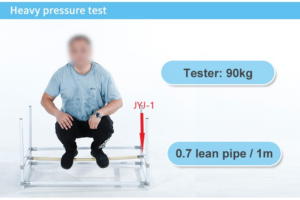
All of these factors — material, thickness, geometry, fastening, and surface treatment — converge in a single output: rated load capacity. A high-strength metal pipe connector joint carries a rated load that reflects its ability to maintain structural integrity under that load. This rating is not a single number but a profile that may include static load, dynamic load, and specific load direction limits.
Specifying a high-strength joint means matching the joint’s rated capacity to the application’s actual loads. Over-specification wastes capital. Under-specification risks failure.
The engineering judgment lies in understanding the load profile — static versus dynamic, vertical versus horizontal — and selecting a joint whose rated capacity provides adequate margin.
We recognise that strength is not a single feature when designing high-strength metal pipe connector joints at Junyi. Due to material grade and thickness laying the groundwork, connection geometry spreading the load, fastening technique clamp force, and surface treatment keeping these attributes throughout time.
High strength does not come from thickness alone. It comes from material, geometry, fastening method, and load distribution working together to deliver structural integrity under real operating conditions. That is what ensures the joint performs as designed — and that is what makes it high-strength.