The typical assembly line operator is often assumed to be right-handed and able to reach shoulder height, but that does not reflect the full range of your workforce. Operators vary in height. Some have injury-related reach or repetition issues. Over months, eight-hour-a-day uncomfortable postures cause discomfort in operators.
Static workstations force workers to adapt their bodies to fixed infrastructure. Flexible workstations, built with lean pipes, allow infrastructure to adapt to worker bodies instead.
How Static Workstations Create Ergonomic Liabilities
Fixed workstations generate cumulative physical stress. An operator reaching 2 inches above comfortable shoulder height performs thousands of overhead reaches daily. Over weeks, this creates shoulder fatigue and strain. An assembly height 4 inches too low forces constant bending, stressing the lower back. Repetitive motion in awkward positions accelerates injury risk.
Traditional workbenches—welded frames with bolted components—can’t accommodate individual differences. Adjusting a single station costs hours of downtime and engineering time. Most facilities accept that some operators will be uncomfortable rather than invest in redesign.
The cost isn’t obvious until injuries occur. Repetitive strain injuries (RSIs) create lost time, reduced productivity, worker compensation claims, and difficulty retaining experienced staff. Prevention through ergonomic design is more cost-effective than managing injuries after they develop.
Additionally, static workstations often fail to accommodate workflow variations. When product design changes slightly, the workstation layout becomes suboptimal. Operators work around obstacles rather than removing them. Small inefficiencies compound into measurable productivity loss.
Why Lean Pipe Systems Enable Rapid Ergonomic Adjustments
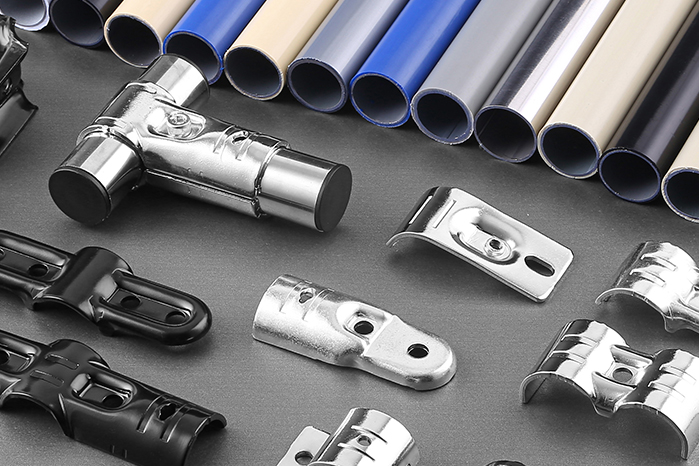
Modular lean pipes and clamp-on metal joints allow you to adjust workstation geometry without downtime or engineering resources. Height adjustments, reach optimizations, and component repositioning happen during routine maintenance or between production runs.
This flexibility transforms ergonomics from a one-time design decision to an ongoing optimization process. When an operator reports discomfort or you observe awkward postures, you adjust the workstation to match that operator’s needs. When product design changes, you reconfigure the layout to optimize the new workflow.
The adjustment mechanisms are straightforward. Supports mounted on adjustable rails allow height changes across a range (typically 6–12 inches). Repositionable tool holders and material staging areas adjust based on operator feedback. Horizontal work surfaces can shift forward or back to optimize reach distances.
At Junyi, our lean pipe systems include quick-release mechanisms that enable these adjustments without bolts or tools. A supervisor can modify a workstation in 15–30 minutes, often without stopping production if adjustments happen during scheduled breaks.
Height and Reach Optimization for Diverse Operator Bodies
Ergonomic comfort depends partly on matching task geometry to operator anthropometry—the actual body dimensions of your workforce.
Work surface height significantly influences comfort and injury risk. For standing assembly tasks, ideal height is typically 2–4 inches below elbow height, allowing elbows to bend slightly and weight to distribute through the torso rather than shoulders. For an operator 5’4″, this differs from an operator 6’2″. Standard workbenches at 36 inches suit average-height operators but force shorter operators to reach up and taller operators to bend down.
Adjustable-height work surfaces accommodate this variation. A range of 30–42 inches covers most operator populations. Operators adjust their station to their comfortable height, reducing neck and shoulder strain.
Reach distances affect postural strain. Materials positioned too far require stretching and shoulder stress. Positioning too close creates awkward bending or elbow crowding. Optimal reach distance is roughly 12–18 inches from the operator’s standing position, varying based on task and individual preference.
Modular lean tube systems allow repositioning of material staging, tool holders, and assembly fixtures to match each operator’s optimal reach. When a new operator with different body dimensions takes the station, the workstation adjusts to their reach zone.
Document the adjustments made for each operator. Over time, you’ll recognize patterns—shorter operators consistently move materials closer, taller operators adjust height upward. Use these patterns to pre-configure new stations, reducing setup time for new workers.
Reducing Repetitive Motion Stress Through Workstation Flexibility
Repetitive strain injuries develop when the same muscle groups perform identical motions thousands of times daily without variation. Changing the workstation layout periodically introduces motion variation, reducing strain on any single muscle group.
A workbench where assembly requires reaching to the right all day stresses right-shoulder muscles continuously. If the workstation can be reconfigured so assembly alternates between left-reach and right-reach tasks, or between reaching and lower-body tasks, strain distributes across different muscle groups. This variation is a known injury-prevention strategy.
Modular systems enable this variation. By repositioning material staging or rotating which assembly step happens at which station, you introduce movement variety. The added logistics complexity is minimal—modern facilities handle such adjustments routinely—but the ergonomic benefit is significant.
Additionally, task rotation across multiple workstations (each with slightly different geometry or reaching requirements) naturally distributes strain. Operators can rotate through stations every 1–2 hours rather than remaining in identical postures all shift.
Measuring Ergonomic Improvement Before and After Redesign
Quantifying ergonomic improvement requires baseline measurement. Before redesigning a workstation, document the current state.
Postural observation reveals stress indicators. Video-record operators completing a full work cycle, noting postures: shoulder height during reaches, spine flexion during bending, neck positioning. After workstation adjustment, record the same operator performing the same task. Compare postures—improved ergonomics show reduced reach distances, more upright spine, and less shoulder elevation.
Operator feedback is direct data. Ask operators to rate discomfort on a 0–10 scale before and after changes. While subjective, consistent feedback from multiple operators reveals whether changes improved comfort. Reduced pain complaints correlate with reduced injury risk.
Cycle time sometimes improves with better ergonomics. If awkward postures force slow, careful movements, ergonomic improvement often speeds task completion. However, don’t assume cycle time always improves—some ergonomic changes trade speed for sustainability, accepting slightly longer cycle times to reduce fatigue and injury risk.
Attendance and retention are long-term indicators. If ergonomic improvements reduce pain-related absences or increase retention of experienced workers, the investment paid off financially, not just ergonomically.
Sustaining Gains Across Multiple Production Lines
Ergonomic improvements at one workstation create a template for others. Document your optimizations and apply them systematically across all similar stations.
When you discover that adjusting a station height from 36 to 40 inches eliminated complaints from taller operators, apply that height to all similar stations. When you identify an optimal material-staging distance, configure that distance consistently. Standardization means every operator encounters predictable, ergonomic geometry regardless of which station they occupy.
At Junyi, our modular lean pipe systems support standardization by offering identical components across multiple installations. Ordering identical kit configurations for each production line ensures consistency. Documented adjustments become repeatable across your facility.
Train supervisors to recognize ergonomic problems and make adjustments. A supervisor who understands that a worker’s persistent posture suggests suboptimal height or reach can adjust the workstation proactively, before pain complaints develop.
From Fixed Discomfort to Adaptive Workplaces
Manufacturing lines designed with fixed geometry force workers into accommodations. Workers with bodies that don’t match design assumptions experience cumulative stress.
Lean pipe systems enable workstations that accommodate the workforce you actually have, not the workforce you designed for. Adjustments happen quickly and without friction, making ergonomic optimization practical rather than theoretical.
The result is reduced fatigue, fewer ergonomic injuries, better retention of experienced workers, and a production line where infrastructure supports human performance rather than constraining it.