Product moves efficiently along a defined route on automated conveyors. That’s their strength and weakness. When production mix changes, human activities must interface with automated lines, or material handling needs alter, fixed conveyor layouts become a restriction.
Lean tube systems complement automated conveyors with modularity. Lean tube constructions and conveyors cannot be integrated simply by positioning them next to each other. It involves careful interface design, material flow continuity, and structural compatibility.
Identify Where the Conveyor Needs Supplementation
Automated conveyors excel at long-distance transport and high-throughput movement. They are less effective at accumulation, manual intervention, sorting, or temporary storage. These are the gaps where a lean tube system adds value.
Walk the conveyor line and document every point where product currently stops, where operators interact with the line, or where bottlenecks occur. These are the integration opportunities.
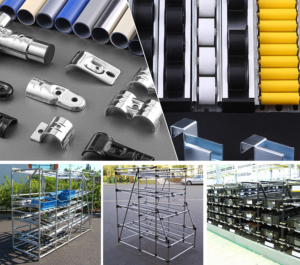
At Junyi, our lean tube system can incorporate gravity-fed accumulation lanes at the conveyor discharge, roller track workstations next to the conveyor for human assembly, or flow racks at conveyor transfer points to buffer goods. Integration must meet operational needs, not merely add hardware.
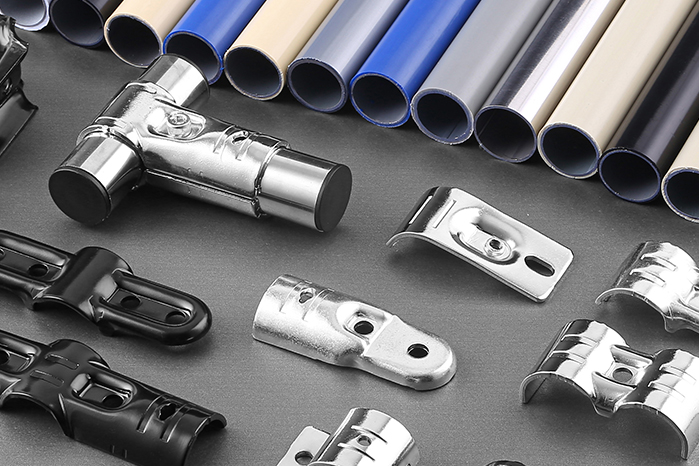
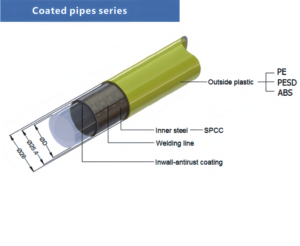
The coated pipe, called a lean tube in lean manufacturing techniques, is durable and versatile for industrial purposes. It complements automated conveyors because of its versatility. Welded steel with a plastic covering and anti-corrosion layer makes the pipe strong and versatile.
The standard diameter is 27.8mm±0.2mm, and the outer layer can be PE, ABS, or ESD plastic, allowing the system to match the environmental requirements of the conveyor area.
Assess the Conveyor Interface Before Designing Anything
Understanding what you’re connecting to starts integration. Record belt, roller, slat, or chain conveyors. Measure conveyor height, breadth, and distance from overhead impediments. Find the speed and direction.
The conveyor-lean tube interaction is crucial to design. Product transferred from the conveyor onto a lean tube roller track must match height within a tolerance to avoid tipping or jamming. The height of a lean tube workstation next to the conveyor must match the conveyor surface for ergonomic material transfer.
The lean tube system uses metal joints to connect the coated pipe. A metal joint is a component with a dovetail-shaped snap at the head, which connects to the lean pipe through the snap and the screw.
It has an electroplated coating on the surface and a long service life. This connection system allows precise adjustment of angles and heights during assembly, which is essential when matching the lean tube structure to existing conveyor dimensions.
Design the Lean Tube Structure Around Material Flow, Not Convenience
With the interface points defined, design the lean tube structure to support continuous material flow. The structure should extend the conveyor’s capability, not interrupt it.
For accumulation, design gravity-fed roller track lanes that slope slightly downward from the conveyor discharge. The roller track system is easy to install and runs smoothly.
It improves material handling efficiency and ease in workshop material racks. The roller track should pull goods away from the conveyor under its own weight to create buffer capacity without powered equipment.
The lean tube frame should support the product at a reasonable height for manual workstations. Install component shelves, tool rails, and fittings. The frame must not alter during operator engagement.
Create lean tube bridges or diverters to move goods between conveyor segments. These may have guide rails, side rollers, or adjustable stops. The modular lean tube system may be changed to meet product size and flow needs.
Throughout the design process, maintain clear access for maintenance and cleaning. The lean tube structure should not obstruct conveyor service points or create safety hazards.
Plan for Continuity at the Transfer Points
Integration succeeds or fails at the transfer point, as product goes from the automated conveyor to the lean tube system. Both methods fail if product clogs, tips, or misaligns at the transfer point.
Create a positive handoff. The gravity roller track should start somewhat lower than the motorised conveyor surface so product descends onto the rollers rather than catching on the leading edge. Product from a lean tube construction should be guided squarely onto a conveyor.
Use guide rails on both sides of the transfer point to keep product aligned. The guide rails can be made from coated pipe mounted with appropriate joints. Adjustable stops at the end of gravity lanes allow operators to control when product releases onto the conveyor.
Consider the product characteristics at the transfer point. Weight, dimensions, and surface friction all affect how product behaves during transfer. Test the transfer with actual product before committing to the final design.
Execute in Phases and Validate With Real Loads
Integration should not shut down the conveyor for extended periods. Plan the installation in phases, starting with structures that can be assembled offline and then positioned into place.
Build the lean tube structures in a staging area away from the conveyor. Use the modular components — coated pipes cut to length, metal joints, and roller track — to assemble each structure completely.
Place and fasten the completed structure to the conveyor frame or floor. This reduces conveyor downtime and facilitates pre-installation quality inspections.
Run product through integrated system at regular speed after installation. Check transfer points for clogs or misalignment. Manual station throughput should be measured. Lean tube heights, slopes, and guiding rails may be adjusted as needed.
At Junyi, our approaches lean tube system integration with the awareness that every conveyor line is unique. We provide custom-configured coated pipes, metal joints, and roller track components to complement current equipment.
Integration is not about putting a standard solution onto a non-standard line. Modular components are used to create what the operation requires, where it needs it, and adapt it as needed.
Adding a lean tube system to an automated conveyor gives a fixed asset flexibility. The conveyor underpins. Adjustable material handling, accumulation, manual workstations, and flow control are provided by the lean tube system.
When the integration is planned around material flow rather than convenience, the result is a system that handles today’s product mix and adapts to tomorrow’s.