Equipment vibration is a persistent condition on manufacturing floors. Conveyors, presses, pumps, and material handling equipment all generate forces that transmit through supporting structures.
Over time, these forces cause connections to loosen, components to wear, and structures to become unstable. Specialized coated pipe and joint systems can help maintain connection integrity in structures exposed to repeated operating loads and vibration.
Why Equipment Vibration Affects Manufacturing Structures
Vibration is more than annoying. It causes measurable production losses. Regular retightening of loose joints takes time. Accelerated component wear reduces equipment life. Structural instability reduces assembly and measurement precision, lowering product quality.
Traditional welded frames transmit vibrations through inflexible connections that cannot absorb movement. Cumulative degradation damages equipment and goods. Connection stability with constant shaking is the key problem. The design of pipe and joint assemblies is crucial here.
Connection Integrity Under Cyclic Loading
Vibration-related joint failure is often a progressive process rather than an immediate event. Small relative movements may not cause immediate failure, but repeated cycles can gradually reduce joint stability.
Vibration imposes cyclic loading on every connection in a structure. Each cycle applies a small amount of force that can gradually move components relative to each other. Over thousands or millions of cycles, these micro-movements accumulate. Connections that started tight develop clearance. Clearance allows more movement. More movement accelerates loosening.
The rate at which this occurs depends on several factors: the clamping force at each joint, the fit between pipe and connector, the surface condition of both components, and the magnitude and frequency of the vibration. Assemblies that maintain consistent fit and adequate clamping force resist this loosening process more effectively.
Reinforced Joint Design for Greater Clamping Force
The connection point is where stability is either preserved or lost. Standard joints with minimal surface contact allow micro-movement between connected pipes. Over time, these micro-movements become loose joints and unstable structures.
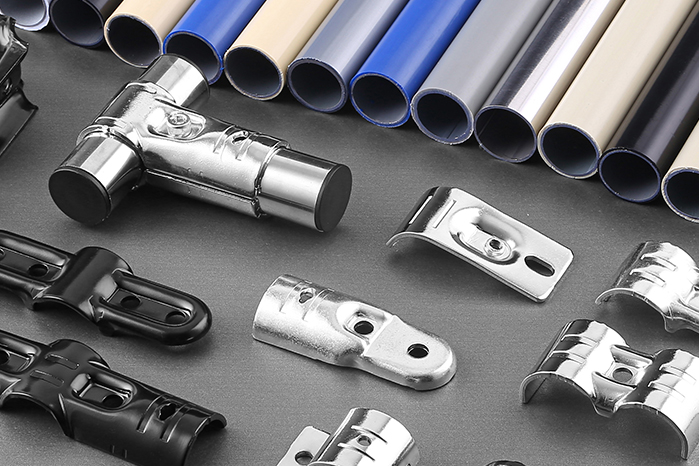
Our metal joints at Junyi address this through a reinforced design. Long strip stiffeners—two at the head and two at the tail, arranged in a jagged, three-column pattern—help increase clamping and pulling force.
This design helps ensure connections within tube and joint systems maintain their integrity under operating loads. The increased contact area and clamping force help limit micro-movement at the joint.
Reducing micro-movement at the joint helps limit unwanted relative movement and improves the stability of the assembled structure under vibration. The jagged pattern creates multiple contact points that distribute force evenly, preventing the localized stress that leads to loosening.
Coating Consistency and Fit Quality
The coating on the pipe plays a critical role in connection stability. Inconsistent coating thickness creates gaps between the pipe and the joint. These gaps allow movement. Even small gaps become sources of relative movement under vibration, accelerating the loosening process.
Specialized coated pipe and joint systems apply plastic coating with precise, even thickness. This helps ensure a consistent fit between the coated pipe and metal joint, meeting stringent assembly requirements.
Compatible manufacturing tolerances help minimize excessive clearance, reducing unwanted movement at the connection. The uniform coating also prevents the uneven wear that creates gaps over time, maintaining the fit quality throughout the service life of the assembly.
Corrosion Resistance That Maintains Connection Integrity
Corrosion is a slow but certain enemy of structural stability. When pipes corrode, their surface changes. Rust and oxidation create uneven surfaces that compromise the fit between pipe and joint. The connection develops clearance. Movement increases. Structural stability degrades.
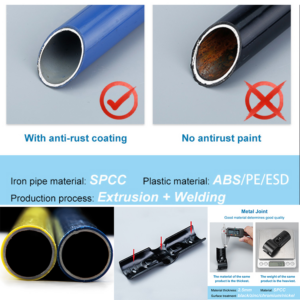
Advanced corrosion protection addresses this at the source. The inner wall of each coated pipe receives a specialized anti-rust spray coating. This protective layer forms a tight, durable bond with the pipe interior, ensuring it does not easily peel or flake off.
This treatment helps maintain the original dimensions and surface quality of the pipe over years of service. A pipe that maintains its dimensional accuracy continues to fit its joint as designed, preserving connection stability under vibration.
Precision Manufacturing for Consistent Assembly
Manufacturing tolerances determine whether a joint fits consistently from the first installation. Poor tolerances mean variable fit. Some connections are tight; others have clearance. Connections with clearance become sources of relative movement and eventual instability.
Precision manufacturing eliminates this variability. Metal joints are produced from SPCC cold-hardened steel plate with a thickness of 2.5mm and dimensional tolerances controlled to within ±0.05mm. This level of precision helps ensure every joint fits every pipe consistently. The consistent fit means consistent clamping across every joint in the assembly. Assembly is not only faster but also more reliable.
During production of every complete lean tube, a critical gas test is performed. High-pressure air is injected into the pipe interior via an air gun to detect any missed welds or perforations.
This inspection helps identify welding defects or perforations before the pipe enters assembly, supporting consistent structural quality across the finished system. Consistent structural quality provides a more reliable foundation for maintaining joint stability under operating loads and vibration.
Design Features That Support Assembly and Safety
Beyond the core stability mechanisms, additional design features support structural integrity. Rounded joint edges improve handling safety, while clear assembly lines help ensure accurate installation and consistent clamping force.
Metal joints are electroplated to resist moisture, chemicals, and temperature fluctuations, helping maintain surface quality and connection stability over time.
At Junyi, we manufacture coated pipe and joint solutions for demanding industrial environments. We use reinforced stiffeners to improve clamping force and apply a uniform plastic coating to support a consistent fit between coated pipes and metal joints. Our anti-rust interior coating helps protect the pipes against corrosion, while precision manufacturing with tolerances controlled to within ±0.05 mm supports consistent joint performance.
For modular manufacturing structures, vibration control starts with connection stability. Consistent fit, corrosion protection, and adequate clamping force help reduce loosening and maintain structural stability in vibration-prone environments. Specialized tube and joint systems provide a reliable foundation for these applications.