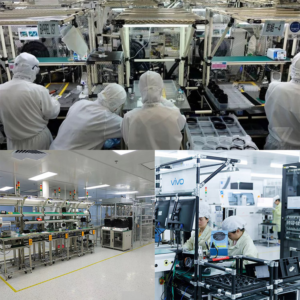
A standard lean tube workbench works perfectly on a factory floor. The same structure installed in a cleanroom? That is a different story.
Cleanrooms impose constraints that standard industrial equipment does not face. Particle generation must be minimized. Corrosion cannot be tolerated. Surfaces must be cleanable. And every component must maintain structural integrity without introducing contamination risks.
Customizing a complete lean tube structure for cleanroom environments means addressing each of these constraints systematically. The tube material changes. The joint design matters more. And the manufacturing quality behind every component determines whether the structure lasts or becomes a liability.
What Changes When Lean Tube Enters a Cleanroom
The fundamental difference is the operating environment. Cleanrooms control airborne particles, humidity, temperature, and sometimes static electricity. Any equipment placed inside must not compromise these controls.
Standard lean tubes with plastic coatings work well in general manufacturing. But in cleanrooms, the coating must resist chemicals used for cleaning and disinfection. The tube ends must be sealed to prevent particle entrapment. And the joints must not create crevices where contaminants can accumulate.
The load requirements do not disappear. A cleanroom workbench still supports components, tools, and products. The structure must be as strong as its factory-floor counterpart while meeting stricter material and surface requirements.
This is where customization begins.
Material Selection for Cleanroom Compatibility
The tube itself is the foundation of any lean structure. For cleanroom applications, material selection focuses on three factors: corrosion resistance, particle shedding, and chemical compatibility.
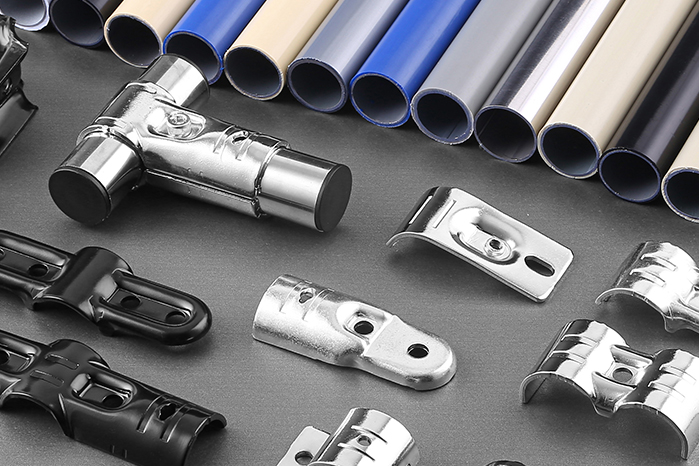
Coated pipes with anti-rust protection address the corrosion concern directly. In our coated pipe and joint systems, the inner wall of each pipe receives a specialized anti-rust spray coating.
This protective layer forms a tight, durable bond with the pipe interior, ensuring it is not easy to peel or flake off. This is critical in cleanrooms where humidity or cleaning agents could otherwise cause corrosion over time.
The coating thickness also matters. The plastic coating on every coated pipe is applied with precise, even thickness. This ensures a perfect fit with metal pipeline joints, meeting the stringent assembly requirements for seamless tube and joint systems. In a cleanroom, uneven coating can create gaps or rough surfaces that trap particles or harbor bacteria.
For applications requiring higher corrosion resistance or where the structure will be exposed to aggressive cleaning agents, stainless steel lean pipes may be specified. We at Junyi offer stainless steel options for demanding environments, with customization available for length, color, and thickness.
Structural Integrity Without Compromise
Cleanroom structures must be just as strong as their industrial counterparts—sometimes stronger, because failure means not just downtime but potential contamination events.
The metal joints are the critical connection points. Every joint must clamp securely and maintain that clamp over years of use. The joint design in our tube and joint systems features long strip stiffeners—two at the head and two at the tail, arranged in a jagged, three-column pattern. This design significantly increases clamping and pulling force, ensuring the connections meet all safety and reliability requirements.
Joint thickness contributes directly to strength. Standard metal joints use SPCC cold-hardened steel plate with a thickness of 2.5mm and an error tolerance of less than 0.05mm. For heavier loads, custom thickness options are available. In one case, At Junyi, we develop a 2.6mm thick metal joint for a distributor, helping them successfully open up a new market.
The load-bearing design extends beyond the joints to the entire structure. For roller tracks and other load-bearing elements, the bearing support uses materials that meet stringent capacity requirements. This robust design significantly improves load-bearing performance to fulfill demanding needs.
Assembly identification features also contribute to structural integrity. Two clear assembly lines are marked on the tail of each metal joint. This design significantly improves assembly efficiency and prevents errors during construction. In a cleanroom, where access may be restricted and installation must be completed efficiently, this error-proofing feature is particularly valuable.
Installation and Assembly in Controlled Environments
Installing a complete lean tube structure in a cleanroom is not the same as assembling it on a factory floor. The installation process itself must not introduce contamination.
This means components should arrive pre-cut and pre-finished wherever possible. We at Junyi offer cutting and assembly services, reducing the need for on-site modification that could generate particles. Components can be packaged in clean packaging to minimize particle introduction during transport.
The assembly process should be efficient and require minimal tools. The metal joints in a complete lean tube system are designed for simple hex wrench assembly. For example, two pieces of our JY-4 metal joint at Junyi can be fastened together to connect three D28mm lean pipes using two sets of M6*25 nuts tightened with a hex wrench. This simplicity reduces installation time and the number of tools that must be brought into the cleanroom.
Assembly lines marked on each joint guide correct orientation, reducing the likelihood of errors that would require rework. In a cleanroom, rework means additional personnel time in the controlled environment and additional contamination risk—so getting it right the first time matters.
A Practical Customization Workflow
For cleanroom managers and engineers specifying a complete lean tube structure, here is a practical workflow:
Step 1 — Define the cleanroom class and environmental conditions. Understand the particle count limits, humidity range, temperature control requirements, and cleaning protocols. These determine the material and finish requirements.
Step 2 — Specify the tube material. For standard cleanroom applications, coated pipes with anti-rust interior coating provide corrosion resistance and a cleanable surface. For aggressive environments or food/pharmaceutical applications, stainless steel may be required.
Step 3 — Determine the load requirements. Calculate the maximum static and dynamic loads the structure will carry. Specify joint thickness and reinforcement accordingly. Standard 2.5mm SPCC joints handle most applications, with custom thickness options available for heavier loads.
Step 4 — Design the joint configuration. Map every connection point in the structure. Identify the angles, the number of pipes meeting at each point, and any special requirements such as adjustability or disassembly for cleaning.
Step 5 — Verify the coating integrity. Confirm that the coating thickness is uniform and that the anti-rust treatment covers all internal surfaces. Any gap or imperfection in the coating is a potential contamination point.
Step 6 — Plan the installation. Coordinate with the supplier to have components pre-cut and pre-finished. Arrange for installation during scheduled cleanroom downtime to minimize disruption.
At Junyi, we manufacture complete lean tube systems and offer customization options to meet different application requirements, including length, color, thickness, and material selection. We apply quality control throughout the manufacturing process, from raw material inspection to final shipment, to help ensure that every lean tube system meets the required quality standards.
A complete lean tube structure for a cleanroom is not a standard product off the shelf. It is a customized system that balances structural strength, contamination control, and installation practicality. Specify the right materials. Verify the manufacturing quality. And design the structure to meet both the load requirements and the cleanroom’s environmental controls. The result is a structure that performs as reliably as any factory-floor equivalent—without compromising the controlled environment it serves.