Unanticipated shock, impact, and drop loads can be accommodated by your roller rail system. Rails designed for continuous, smooth operation degrade quickly when subjected to impact. The profile develops cracks. Surfaces of bearings develop pits. Once smooth-rolling wheels are now bouncing and vibrating.
Material selection in high-impact environments isn’t about choosing the strongest option. It’s about understanding how different materials respond to shock loading and selecting the material whose response matches your operating reality.
How Impact Loading Differs from Steady-State Stress
Impact loading creates stress fundamentally different from continuous loading. Under steady stress, material deformation is gradual and predictable. Under impact, the stress spike is sudden and severe, often exceeding the material’s yield strength momentarily.
When a load drops onto a roller rail, the energy must be absorbed. The rail deforms, then either returns to original shape or permanently deforms. If impact energy exceeds capacity, cracks initiate and propagate into failure.
The material’s response depends on its toughness—its ability to absorb energy without cracking. A brittle material resists deformation but cracks under impact. A tough material deforms plastically, absorbing energy, then returns toward original shape. The trade-off between hardness (resistance to wear) and toughness (resistance to cracking) is central to material selection.
Repeated impacts compound the problem. Thousands of impacts progressively weaken the material. Stress concentration develops at impact points. Cracks initiate microscopically and propagate until failure occurs.
Material selection must account for this cumulative impact mechanism.
Key Material Properties Under High-Impact Conditions
Yield strength indicates the stress level causing permanent deformation. Higher yield strength resists deformation better. However, yield strength alone doesn’t indicate impact performance. A material with high yield strength but low toughness may crack catastrophically under severe impact.
Toughness indicates how much energy the material absorbs before cracking. Materials with high toughness bend and deform under impact but don’t crack immediately. Toughness is more relevant to impact performance than yield strength, though it varies with temperature and loading rate.
Hardness indicates resistance to wear and surface damage. Harder materials resist scratching, pitting, and deformation, maintaining smooth bearing surfaces longer. However, increasing hardness typically reduces toughness—harder materials become more brittle.
Fatigue strength indicates response to repeated stress cycles. A material tolerating one impact might fail after thousands of repetitions as stress cracks propagate. High-impact environments require fatigue resistance.
These properties interact and conflict. Successful selection requires balancing properties according to your specific conditions.
Steel Options: Hard vs. Tough Trade-offs
Steel dominates roller rail applications because it can balance multiple properties. Different steel grades optimize different characteristics.
Mild steel (low carbon, under 0.3%) is tough and resists cracking but wears quickly under rolling loads. Bearing surfaces degrade within months. Mild steel requires frequent replacement, making it unsuitable for high-impact applications despite good impact resistance.
Medium-carbon steel (0.4–0.6% carbon) provides compromise between hardness and toughness. It resists wear better than mild steel while retaining reasonable impact resistance. Most standard roller rails use medium-carbon steel because this balance suits typical high-impact conditions.
High-carbon or alloy steel (0.7–1.2% carbon, with chromium or molybdenum) offers superior hardness and wear resistance. These materials maintain smooth bearing surfaces longer. However, they’re less tough than medium-carbon versions and develop stress cracks more readily under severe repeated impact.
Hardened and tempered steel undergoes controlled heat treatment to achieve specific hardness-toughness balance. Tempering reheats hardened steel to a precise temperature, controlling brittleness and allowing optimization for specific applications.
The choice depends on your impact severity and frequency. Mild to moderate impact tolerates high-carbon steel’s brittleness. Severe impact environments benefit from medium-carbon steel or specially tempered formulations prioritizing toughness.
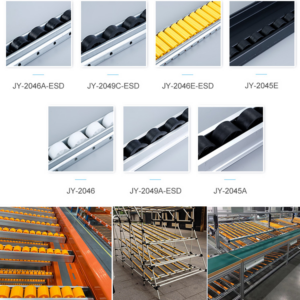
For roller rail applications where galvanized steel is preferred, our JY-2046 roller track at Junyi provides a practical material option. The track is made from galvanized sheet with a 0.8 mm wall thickness and uses PP or ESD wheels. Its galvanized surface treatment helps protect against rust, while the hollow, irregular-shaped bending structure improves bending resistance and supports long-span installation. The specified maximum load-bearing capacity is 150 kg/m, making it suitable for material handling, warehouse, production-line, and guide-rail applications.
Aluminum and Composite Alternatives
Aluminum alloys (6061, 7075) are significantly lighter than steel and resist corrosion naturally. However, they’re softer and wear faster under rolling loads. Hard-coat anodizing creates a wear-resistant surface, allowing aluminum to perform in moderate-impact environments where weight reduction is valuable. Aluminum’s lower stiffness is a disadvantage—it deflects more under impact, potentially affecting equipment alignment.
Composite materials (CFRP) offer weight reduction and corrosion resistance. However, composites absorb impact energy through material damage—matrix cracking, fiber breakage—rather than elastic deformation. This damage accumulates, eventually compromising integrity. Composites perform poorly in high-impact industrial environments with repetitive impacts.
Steel remains the practical choice for most high-impact roller applications.
Assessing Your Actual Impact Profile
Material selection should reflect your actual impact conditions, not worst-case assumptions.
Document impact frequency. Do loads drop onto the rail rarely (few times daily) or constantly (hundreds hourly)? Fatigue resistance becomes more critical with higher frequency.
Estimate impact severity. A 6-inch drop is lower-energy; a 6-foot drop is severe. Drop height and load weight determine impact energy, revealing whether your rail needs maximum toughness or moderate toughness.
Identify load distribution. Does impact occur in the same location or distributed across the length? Concentrated impacts cause localized stress cracking.
Consult equipment documentation. Equipment manufacturers often specify material requirements, reflecting actual loads imposed.
Material Verification Before Installation
Inspect for shipping damage. Impact during transport can initiate stress cracks or cause dents that may affect performance during service. Visually inspect roller tracks for dents, gouges, deformation, or other visible damage before installation.
Verify material and specifications. For example, our JY-2046 roller track at Junyi is manufactured from galvanized sheet with a 0.8 mm wall thickness and has a specified maximum load-bearing capacity of 150 kg/m. Confirm that the delivered roller track matches the required material, dimensions, and load conditions for your application.
Confirm proper support and alignment. Poor installation—inadequate support or misalignment—can cause premature failure even when the selected material is suitable. Verify that the roller track is adequately supported and that the bearing surfaces align properly.
Matching Material to Impact Reality
High-impact roller rail applications demand material selection reflecting actual operating conditions. The hardest material available isn’t always best—excessive hardness can sacrifice toughness necessary to resist cracking.
Understanding trade-offs between hardness, toughness, and fatigue resistance, combined with honest assessment of your impact profile, guides material selection that balances wear resistance against cracking risk.