In the intricate world of industrial engineering, the most significant impact often comes from the smallest components. At the base of every mobile workstation, transport rack, and logistics trolley lies a fundamental piece of hardware: the caster. While the terms “wheel” and “caster” are often used interchangeably in casual conversation, in a professional 2B industrial context, they represent a sophisticated assembly designed to manage load, direction, and safety. Understanding the distinction and the mechanical advantages of high-quality casters wheels is essential for any facility aiming for lean manufacturing excellence.
Decoding the Caster: More Than Just a Wheel
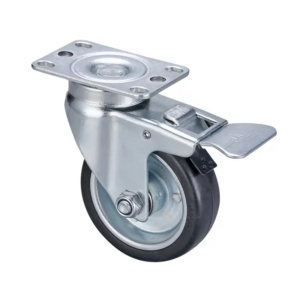
To define it simply, a wheel is a circular component that rotates on an axle. A caster, however, is a complete housing assembly that includes the wheel and a mounting bracket. This assembly allows the wheel to be attached to a piece of equipment.
From a popular science perspective, casters are categorized into two primary mechanical designs:
- Rigid Casters: These are designed for linear movement. They allow the equipment to move forward and backward in a straight line, providing excellent tracking and stability for long-distance transport.
- Swivel Casters: These feature a raceway of ball bearings that allows the wheel to rotate 360 degrees. This is the “steering” mechanism of the industrial world, enabling operators to navigate tight corners and reposition equipment in confined spaces with minimal effort.
The integration of these two types—typically two rigid and two swivel—creates the “steering geometry” necessary for a standard industrial cart. Without the specialized engineering of casters wheels, the modularity and agility of the modern factory floor would cease to exist.
The Strategic Why: Why Professional Facilities Use Casters
The decision to put equipment on wheels is driven by the core tenets of “Lean” production: the elimination of waste and the optimization of flow. There are three primary reasons why high-performance casters are a requirement for 2B enterprises:
- Dynamic Facility Reconfiguration
In modern manufacturing, production lines are no longer static. As product designs evolve, the floor layout must change. Equipment mounted on high-quality casters wheels can be reorganized in minutes rather than days. This flexibility allows businesses to respond to market demands without the heavy costs of traditional millwrighting and permanent installation.
- Ergonomic Safety and Energy Efficiency
Moving heavy raw materials or sub-assemblies manually is a high-risk activity for worker fatigue and injury. Professional casters are engineered to reduce “initial push force.” By utilizing precision-sealed bearings and optimized tread materials, the energy required to overcome inertia is minimized. This protects the workforce and ensures that movement is smooth and controlled, even under heavy industrial loads.
- Vibration and Static Management
In high-tech sectors, the wheel is a protective barrier. Facilities dealing with sensitive electronics or calibrated diagnostic tools require casters that dampen vibration. Furthermore, in environments where friction can cause static buildup, specialized rubber wheels act as an essential grounding path, preventing Electrostatic Discharge (ESD) from damaging expensive inventory.
Engineering Excellence with JunYi: Your Industrial Mobility Partner
At JunYi, we specialize in the manufacturing of the structural “connectors” of industry. While our expertise covers modular piping and joint systems, we recognize that mobility is the final piece of the productivity puzzle. As a dedicated B2B manufacturer, we provide the hardware that allows your facility to remain in constant, safe motion.
Our JunYi Medium-Sized Black Anti-Static Rubber Caster is engineered specifically for the rigors of the 2B sector. We don’t just supply a part; we supply a technical solution for manufacturers, logistics providers, and facility integrators who demand consistency and durability.
Technical Specifications of the JunYi Caster Series
Our casters wheels are built to meet international standards for industrial use. When you choose our mobility solutions, you are investing in the following technical specifications:
The JunYi Advantage: OEM and ODM Solutions
We understand that every industrial application has unique requirements. A caster used in a cleanroom for semiconductor assembly has vastly different needs than one used in an automotive parts warehouse. That is why JunYi offers comprehensive OEM and ODM services.
Our engineering team can customize the durometer (hardness) of the rubber to match your floor’s friction coefficient, or adapt the swivel torque to ensure your carts handle exactly as your operators expect. By using “we” and “our” in our partnership with you, we emphasize that your success is our primary manufacturing goal.
Our rubber wheels are not merely designed to roll; they are designed to endure. We utilize high-grade carbon-infused rubber to ensure that our black casters provide a continuous path to ground while resisting the “chunking” and wear common in lower-grade consumer alternatives.
In the competitive world of 2B supply, the difference lies in the details—the smoothness of a bearing, the resilience of a tread, and the reliability of a brake. At JunYi, we provide the foundation for your facility’s mobility, ensuring that every movement is a step toward greater efficiency.