Floor space is the most expensive asset in any distribution center. Yet many DCs operate with layouts that prioritize accessibility over density, dedicating significant floor area to aisles rather than storage positions. The pressure to store more SKUs, handle higher volumes, and reduce square footage costs has pushed warehouse operators toward high-density storage solutions.
At Junyi, we provide roller track components for pallet flow rail systems designed to help distribution centers maximize storage density. Roller track — a core component of pallet flow rail systems — offers one of the most effective responses to that pressure. But integrating it requires understanding not just what it does, but how it changes the entire storage equation.
The Storage Density Challenge in Distribution Centers
Selective pallet racking is the default choice for good reason: every pallet is immediately accessible. But that accessibility comes at a cost. Each aisle serves only the pallet positions immediately adjacent to it, and aisle space can consume a significant portion of total floor area. As land costs rise and DC footprints stay flat, that inefficiency becomes increasingly unsustainable.
The alternative is multi-deep storage — storing pallets two, three, or more positions deep in a single lane, with only one aisle serving that lane. Pallet flow rail achieves this through a gravity-fed mechanism that automatically moves pallets from the load side to the pick face, combining multi-deep density with disciplined inventory flow.
What Roller Track Is and How It Works
A pallet roller track— also known as a smooth rail — is a roller track system that is easy to install and runs smoothly. It consists of a series of rollers mounted within a track, allowing pallets or containers to move along the track with minimal friction.
In a pallet flow rail system, these roller tracks are installed at a slight incline within a static rack structure. Pallets are loaded from one end — the replenishment aisle — and gravity moves them along the roller track toward the opposite end, the picking aisle. Each lane can store multiple pallets in sequence.
When a pallet is removed from the pick face, the next pallet rolls forward automatically. This is the core mechanism that delivers density: instead of one pallet per aisle-facing position, a flow lane can store multiple pallets deep while requiring only two forklift aisles — one for loading and one for picking.
Density Gains Through Multi-Deep Storage
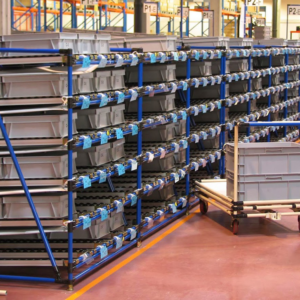
The density improvement from roller track-based flow systems is substantial. By storing pallets multiple positions deep in each lane, the system dramatically reduces the number of aisles required. With only two aisles per flow rack block — versus an aisle between every row in selective racking — the floor area devoted to travel paths drops significantly.
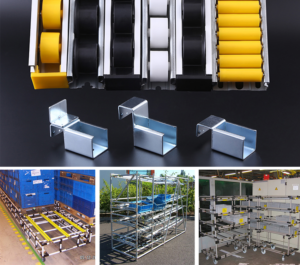
Roller track systems are widely used in scenarios such as workshop material racks and can effectively enhance the efficiency and convenience of material handling. This efficiency gain comes from two factors: reduced aisle count and deeper lane utilization.
Fewer aisles mean more floor area dedicated to actual storage. Deeper lanes mean each aisle-facing position holds more pallets. The result is a storage density that far exceeds what selective racking can achieve.
FIFO Inventory Flow Without Extra Effort
Density is valuable, but density without inventory discipline creates problems. In drive-in racking, pallets are retrieved in Last-In, First-Out (LIFO) order because the retrieval aisle is the same as the loading aisle. This works for bulk storage of identical products but creates rotation issues for products with expiration dates or model-year relevance.
Roller track-based flow systems enforce First-In, First-Out (FIFO) automatically. The first pallet loaded into a lane is the first pallet that reaches the pick face. This is not a process requirement that operators must remember — it is a physical consequence of the gravity-fed design.
For distribution centers handling perishable goods, consumer packaged goods with seasonal rotation, or any inventory where age matters, FIFO is non-negotiable. Roller track delivers FIFO without sacrificing the density that multi-deep storage provides.
Practical Considerations for Roller Track Integration
Roller track is not a universal solution. The system works best with uniform pallet types, consistent load weights, and clearly defined loading and picking requirements. Proper installation also requires attention to incline angle, roller spacing, track alignment, and load capacity to ensure reliable pallet movement and consistent flow performance.
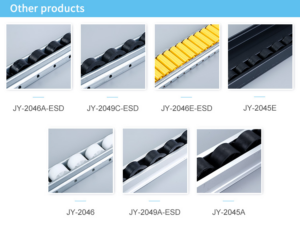
For operations evaluating different roller track configurations, we at Junyi offer a range of roller track and smooth rail components designed for applications where smooth material movement and efficient storage are priorities. Our roller track product range includes models such as JY-2045, JY-2045DE, JY-2046, JY-2047, JY-2049, and JY-2049B, providing options for different rack and material-handling requirements. Our company’s roller track solutions are designed for easy installation and smooth running, and can be used in material racks and other storage applications where improving handling efficiency is important.
Integration decisions should still be SKU-specific rather than facility-wide. For high-volume SKUs with predictable turnover, the density gain from pallet flow systems can justify the investment in roller track. For slow-moving items, however, the reduced accessibility of deeper lanes may not provide enough operational benefit. Selecting the appropriate roller track specification, length, and configuration is therefore essential to matching the storage system with its intended application.
We at Junyi also support customization of roller track specifications, including different lengths and configurations, which can be useful when integrating roller track into existing racks or designing a new material-handling system. The company operates a dedicated roller track production line and provides manufacturing and customization capabilities for lean-material and material-handling components.
The decision to integrate roller track into a pallet flow system is ultimately a question of trade-offs: aisle space versus lane depth, accessibility versus density, FIFO discipline versus equipment cost. For distribution centers where floor space is constrained and inventory turns are high, the trade-off can favor flow rail. But the gains only hold when the roller track is properly specified, installed, and maintained for the application.