Your warehouse team is working harder than your racking is. Cases move through pick stations manually. Restocking requires constant repositioning. Inventory sits longer than it should because accessing the back of a bay means moving everything in front first. You know there’s a better way, but the prospect of redesigning your entire operation feels overwhelming.
Flow rail racking eliminates these bottlenecks by letting gravity and incline do the work humans currently handle. The challenge isn’t whether it works—it’s knowing where to start and how to implement it without paralyzing your operation.
Diagnosing Why Your Current Racking Isn’t Moving Inventory Efficiently
Before upgrading anything, understand what’s actually slowing you down. Many warehouse managers assume their problem is labor, when the real constraint is that their infrastructure forces inefficient workflows.
Watch your pick operations for one full shift. Where do pickers spend time? If they’re constantly reaching to the back of deep bays or lifting cases repeatedly from the same height, your racking layout is working against them. If products sit in staging areas waiting for space to clear, your system lacks flow.
Ask your team directly: “Where would a better racking system save you time?” Frontline warehouse workers often identify improvements that overhead misses. Their feedback reveals whether your problem is capacity, accessibility, or dwell time.
Standard static racking treats each bay as isolated storage. Cases go in, sit stationary, and come out only when someone retrieves them. This approach works for slow-moving inventory but becomes expensive for high-velocity products that need continuous replenishment.
Mapping Your Product Profile Against Flow Rail Capabilities
Not every product benefits equally from pallet roller track systems. Understanding your inventory’s movement profile determines where flow rail racking delivers the highest impact.
Products that move quickly—fast-moving consumer goods, high-volume SKUs, items with seasonal demand spikes—gain the most from gravity-fed flow systems. A case that turns over weekly benefits from automatic repositioning. Slower-moving items with irregular demand may not justify the investment.
Document your top 50 SKUs by volume. Identify which products move in full case quantities and which require piece-picking. Which items have consistent demand, and which spike seasonally? This profile reveals where flow rail racking will compress picking time most dramatically.
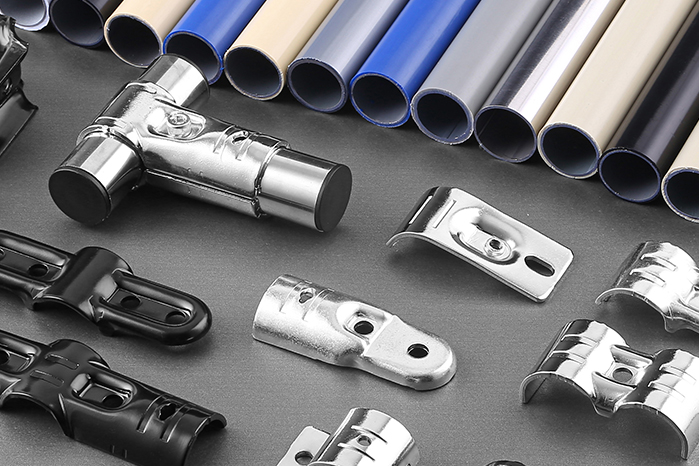
Our pallet roller track systems at Junyi accommodate various case weights and sizes, but matching your inventory to the right system prevents costly misfits. A lightweight goods warehouse needs different roller specifications than one handling dense industrial components.
Calculate your current labor cost for moving cases through your pick operation. This baseline becomes your ROI reference point. If your team currently spends 20 hours weekly repositioning inventory, and flow rail reduces that to 8 hours, you’re quantifying the upgrade’s financial case.
Designing the Layout: Where Flow Rail Racking Works Best
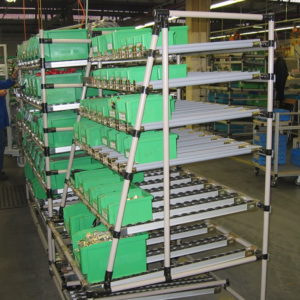
Flow rail racking isn’t an everywhere-or-nowhere decision. Hybrid layouts—combining flow rail for fast-moving products with static racking for slower items—typically deliver the best ROI.
Start with one section of your warehouse. If you operate a 40,000-square-foot facility, dedicate a 5,000-square-foot zone to the pilot. This section should contain your highest-velocity SKUs and represent your most challenging picking workflow. Pilot success makes business case for expansion.
Design the flow rail installation to eliminate backtracking. Arrange your lanes so pickers move in a logical sequence rather than zigzagging. Orient pallet roller track systems to direct products toward pick stations in the same sequence that orders require. When gravity flow aligns with your pick path, efficiency compounds.
Height matters. Flow rail racking positioned at waist height (40–48 inches) minimizes reaching and bending, reducing fatigue and errors. Lower-height installations work for lighter products; higher installations suit dense items picked infrequently.
We at Junyi can help you model your specific layout, accounting for aisle width, forklift clearance, and pick station positioning. This design phase prevents expensive installation mistakes.
The Installation Timeline: Minimizing Warehouse Downtime
Full warehouse shutdowns kill profitability. Your upgrade strategy must run parallel to ongoing operations.
Install flow rail racking bay by bay during lower-volume periods. If your facility peaks midweek, schedule installations for weekends or nights when inventory movement is minimal. Stagger the work so no single day disrupts more than 10–15% of your picking capacity.
Begin installation with non-critical sections. Use early phases to train your team on the new system while keeping high-volume areas operational. Your warehouse staff becomes comfortable with flow rail racking operation and maintenance before it impacts your busiest sections.
The actual installation of pallet roller track systems happens faster than most expect. Our modular roller track components at Junyi are designed for straightforward installation and can be integrated into existing racking structures with the appropriate mounting configuration, helping improve material flow without unnecessarily complicating the storage system.
Plan inventory repositioning carefully. Before converting a bay to flow rail, stage its contents in a temporary location. Once installation completes, load cases back onto the flow system in FIFO (first-in-first-out) sequence so gravity pull aligns with your picking order.
Tuning Your System for Consistent Performance
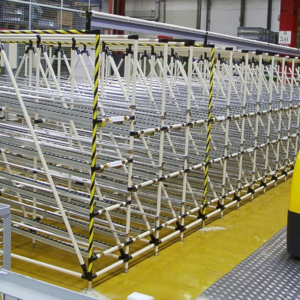
Flow rail racking doesn’t maintain itself—it requires calibration. After installation, spend two weeks adjusting roller tension and incline angles based on actual case weights and movement.
Cases should roll smoothly toward pick stations without jamming or accelerating dangerously. If friction is too high, cases stick; too low, they cascade uncontrollably. Our pallet roller track systems at Junyi include tensioning mechanisms that let you dial in the sweet spot for your specific inventory.
Monitor the first 500 picks through your new system. Record any jams, missed sequences, or operator feedback. Use this data to refine lane assignments and adjust roller settings. This tuning phase typically takes 7–10 working days.
Train your team on height and pace adjustments as inventory changes. Different products may require slightly different settings to maintain optimal flow. Document these settings so all operators maintain consistency.
Validating Results and Planning the Next Phase
After two weeks of operation, measure your improvements against the baseline you established earlier. Compare labor hours, picking accuracy, and inventory dwell time. Most facilities report 25–35% reductions in pick cycle time and similar improvements in labor efficiency.
Document everything. Photograph your pilot installation, record time studies, and capture operator feedback. This documentation becomes your business case for expanding pallet roller track systems to additional sections.
If the pilot succeeds, plan your next phase. Expansion follows the same phased approach—one section at a time, during low-volume periods, with full team retraining before moving to the next zone.
Some facilities discover that flow rail isn’t suited to certain product types or demand patterns. These findings aren’t failures—they’re valuable data that prevents investing in systems that won’t serve you.
From Manual Movement to Automated Inventory Flow
Warehouse upgrades feel risky because they interrupt operations while demanding upfront investment. The step-by-step approach—pilot first, tune second, expand third—removes the risk by proving concept before committing resources.
Flow rail racking isn’t about technology for its own sake. It’s about letting your infrastructure match your operation’s actual rhythm, turning your warehouse into a system where inventory flows rather than stalls.